










Amazon has grown from an online bookstore into one of the largest retail companies globally. The company reported approximately $638 billion in net sales in 2024.1 In Q3 2025, Amazon generated total net sales of nearly $180 billion, a 13.9% year-over-year growth compared to the same quarter of 2024.2 It now serves more than 300 million active customers worldwide, with approximately 230 million based in the U.S.3 Millions of third-party sellers operate on the platform, reinforcing Amazon’s position as a dominant force in global commerce.
For e-commerce brands, Amazon represents a highly attractive channel for growth. Its marketplace offers access to a massive customer base, provides powerful search and discovery features, and enables businesses to expand their reach far beyond traditional retail boundaries. Small brands can scale rapidly, while established companies can diversify revenue streams through Amazon’s multifaceted ecosystem.
A central driver of Amazon’s customer loyalty is Prime, the company’s paid membership program. Launched in 2005 with free two-day shipping as its headline benefit, Prime has expanded over the years to include streaming entertainment, exclusive deals, grocery benefits, and more. In 2023, Amazon relaunched and expanded elements of the Prime program, including widening Seller Fulfilled Prime (SFP) enrollment and updating its premium shipping policies.4
Amazon’s $14.99-a-month program reports more than 200 million Prime members globally,5 with estimates exceeding 180 million members in the U.S.6 Prime members consistently outspend non-members. Average annual spending per Prime customer ranges from $1,1707 to over $1,400, more than double that of non-Prime shoppers.8
Access to Prime customers represents a major opportunity for brands focused on customer acquisition and growth. Prime customers are a loyal, high-value segment with stronger purchase frequency and higher lifetime value. Products carrying the Prime badge benefit from increased visibility and consumer trust, driving a significant boost in conversion and sales velocity. However, earning the Prime badge is challenging. Amazon enforces strict performance requirements, including fast fulfillment metrics, on-time delivery, and low cancellation rates, through an often rigorous trial and eligibility process. Many sellers struggle to meet these thresholds, especially when handling fulfillment independently.
Earning The Prime Badge
Fulfillment by Amazon (FBA)9 has traditionally been the most accessible path to Prime eligibility. Under the FBA model, sellers transfer inventory into Amazon’s fulfillment centers, where Amazon assumes responsibility for storage, order processing, shipping, customer service, and returns. Products enrolled in FBA automatically qualify for Prime, provided inventory remains available within Amazon’s network. FBA allows brands to accelerate Prime eligibility without building or managing their own logistics capabilities. However, this also means giving up control over your brand's fulfillment and customer experience.
Inventory is positioned and moved according to Amazon’s internal logic, limiting a brand's ability to optimize inventory allocation, respond to demand shifts across channels, or control inbound and outbound costs. Fulfillment and storage fees fluctuate and have increased over time. In fact, Amazon just recently rolled out an increase in fulfillment fees for third-party sellers by an average of $0.08 per unit sold.10 This creates significant margin pressure particularly for products with lower price points or slower turnover.
Moreover, brands enrolled in FBA ship orders using uniform Amazon packaging, which prevents the use of branded boxes and marketing inserts, unless enrolled in the Ships in Product Packaging program, but even so, the level of customization remains limited. Customer data also remains largely inaccessible, which restricts visibility into buyer behavior and post-purchase engagement. Over time, many brands find that with FBA, fulfillment becomes decoupled from their broader commerce strategy and ultimately limits their ability to differentiate.
In contrast, under the Seller Fulfilled Prime11 program, brands retain control over inventory placement and fulfillment operations while committing to Amazon’s Prime delivery and service standards. Eligibility requires successful completion of a trial period, followed by ongoing compliance with strict metrics related to delivery speed, on-time shipment rates, cancellation thresholds, and customer experience outcomes.
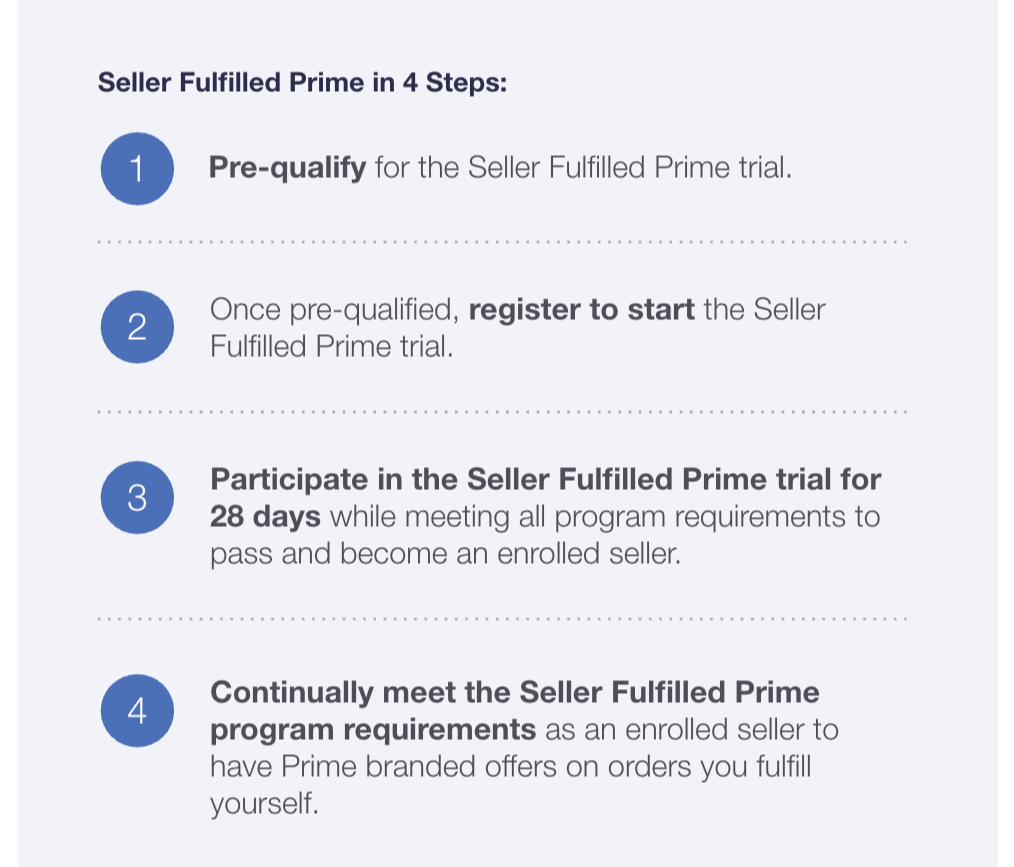
To prequalify for SFP, brands must meet the following criteria over the past 90 days12:
Have shipped at least 100 seller-fulfilled packages
Have a cancellation rate less than 2.5%
Have a valid tracking rate greater than 95%
Have a late shipment rate less than 4%
To pass the trial, brands must meet the following requirements12:
Participate for 4 weeks (28 days)
Ship 100 or more packages from Prime trial orders
Have an on-time delivery rate of at least 93.5%
Have a valid tracking rate of at least 99%
Have a seller-initiated cancellation rate of less than or equal to 0.5%
Consistently ship Prime packages each week of trial
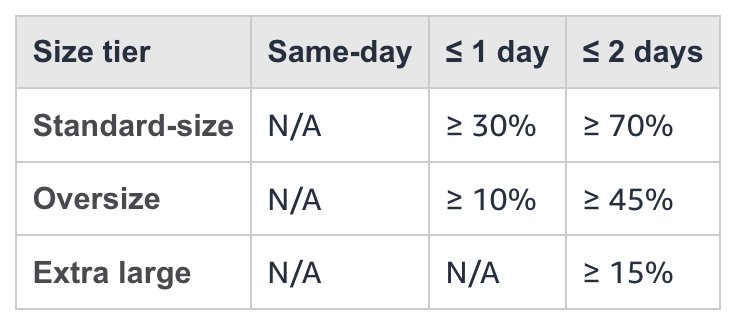
Met the following delivery speed requirements, by size tier:
Products become eligible to display the Prime badge only after successfully passing the SFP trial and securing full enrolment in the program.
To maintain eligibility, brands must match Amazon’s delivery expectations across large portions of the country, manage peak-season volume without service degradation, and maintain near-perfect execution across every Prime order. Failure to meet these benchmarks can result in removal from the program.
However, only a few brands can build and maintain this service level internally without additional capital investment in logistics infrastructure and ongoing operational overhead. Many sellers attempt to bridge this gap through third-party logistics providers. Traditional 3PL models often fall short of Prime requirements due to static warehouse networks, fragmented technology, limited automation, and inconsistent service-level performance. These constraints make it difficult to sustain Prime eligibility without frequent intervention and exposure to risks.
This has ultimately led to a growing interest in fulfillment providers that can support SFP at scale.
Seller Fulfilled Prime Powered by Stord
Seller Fulfilled Prime imposes some of the most demanding operational standards in modern e-commerce. Stord already performs at this level, efficiently meeting Prime delivery expectations while helping brands preserve control and visibility over their fulfillment.
Stord’s SFP solution supports nationwide one- and two-day delivery coverage, same-day order processing, and Saturday fulfillment. Brands that partner with Stord consistently achieve 99%+ on-time fulfillment. These results are driven by Stord’s strategically distributed fulfillment network and its fully integrated commerce enablement and technology stack, which synchronizes order routing, inventory positioning, carrier selection, and real-time performance monitoring across all nodes and channels. These capabilities enable brands to consistently meet Amazon’s SFP delivery and service benchmarks, even during demand spikes and peak sales periods.
Stord’s acquisition of Ware2Go in May 2025 further strengthened its fulfillment network and service density. The expanded coverage increased geographic reach and reinforced Stord’s ability to support SFP programs at scale across a broader range of product profiles.
At scale, Seller Fulfilled Prime becomes Stord Fulfilled Prime: a Prime-eligible fulfillment model built for reliability, visibility, flexibility, and brand-controlled growth.
Stord Fulfilled Prime provides brands with Prime visibility without relinquishing ownership of the customer experience:
Inventory placement and replenishment remain aligned with forecasting and omnichannel demand planning.
Margin economics are significantly improved, particularly for bulky, seasonal, or lower velocity SKUs that are expensive to store in Amazon facilities where fees increase with size and dwell time.
Orders ship in branded packaging with hyper-personalized branded inserts, preserving brand presence throughout the post-purchase experience.
Returns management and customer service quality remain under brand control, allowing consistent and clearer standards for communication and issue resolution while maintaining better post-purchase customer relationships.
From a marketing perspective, Stord Fulfilled Prime strengthens a brand’s position on Amazon. Products qualify for the Prime badge with competitive delivery promises that support conversion and search visibility. Brands retain pricing flexibility supported by improved fulfillment economics. Branded fulfillment execution reinforces differentiation and storytelling within a marketplace environment that often limits both.
Stord-Powered Prime Fulfillment, Brand-Controlled Growth
As opposed to optimizing around Amazon’s fulfillment model, Stord Fulfilled Prime allows brands to scale Prime fulfillment on their own terms.
Prime eligibility becomes part of a broader fulfillment strategy that supports long-term brand trajectory rather than becoming a source of constraint. Inventory strategy, fulfillment standards, margin structure, and customer experience remain aligned under a single infrastructure built to meet Amazon’s requirements at scale.
Stord manages the operational demands of Seller Fulfilled Prime, so brands can focus on growing their brand.
Get started with Stord
Want to explore how Stord can help your brand achieve and scale Prime fulfillment while maintaining ownership of your customer experience? Click below to learn more.


