






What is the State of AI in
E-Commerce in 2026?
The future of e-commerce is becoming increasingly shaped by artificial intelligence. But how and at what pace will this transformation unfold?
To establish a grounded perspective of where AI is headed in 2026 and beyond, and the pathways through which it is likely to evolve, Stord conducted a focused research effort examining consumer adoption and enterprise deployment of AI technologies across the e-commerce ecosystem.
This proprietary 2026 State of AI in E-Commerce Report synthesizes insights on how consumers are using AI-enabled experiences, how brands are responding in practice, and what this evolution means for e-commerce leaders seeking to build durable advantage in this metamorphic phase of AI-driven transformation.
The Consumer Pulse
In 2024, 38% of consumers reported having used generative AI for online shopping.1 In 2025, that figure rose to 51%. This 34% year-over-year increase underscores how rapidly AI is becoming embedded in consumers’ online shopping journeys.
This acceleration signals that traditional levers of digital influence such as paid search, on-site merchandising, and static content will become less decisive as conversion drivers over time. Definitively, AI use is redefining how demand is captured in e-commerce. Brands that adapt to this new dynamic will be better positioned to remain visible and relevant as consumer journeys continue to consolidate around intelligent intermediaries.
Other key Insights

17% of consumers regularly use AI for shopping, translating to approximately 45-50 million U.S consumers.

37% of Gen Z consumers actively use AI to shop online, followed by Millennials at 29%.
50% of Baby Boomers are skeptical of using AI for shopping, citing their distrust of AI recommendations or giving any AI tools their personal information.
Zero-click buying era is expected to dominate e-commerce in 2026.
20% of consumers are more likely to convert when a product or online store is recommended by AI.
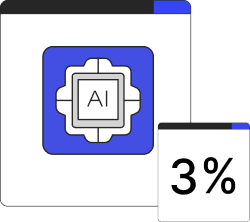
3 percentage point year-over-year growth is expected in the use of AI to find better deals and discounts.

30% of consumers say they would never allow AI to handle shopping or access their payment information. Trust, privacy, and security remain a critical concern.

16% of consumers are very comfortable with AI using their payment information to complete purchases, while 21% are open to AI-assisted shopping provided they can review transactions first.
While AI adoption increased from 78% in 2024 to 88% in 2025,2 this near-universal use masks a significant maturity gap where only 7% of organizations have reached a fully scaled stage. This disparity reveals a scaling gap in which 92% of brands are increasing investments while 99% still lack the mature framework necessary for full integration.3
Organizations that move beyond isolated pilots to achieve true structural transformation are outperforming the market, realizing 40% higher revenue4 and a 30% increase5 in Customer Lifetime Value (CLV). For the modern brand, the objective has shifted from basic implementation to the deep integration required to bridge the divide between digital intent and physical execution.
Other key Insights
- 88% of organizations report regular use of AI in at least one core function, a significant increase from 78% in 2024.
- Only 7% of organizations are fully scaled despite massive AI adoption.
- 31% of brands are currently in the scaling phase, moving beyond initial tests to standardized departmental use.
- 62% of organizations remain in the early stages, with 30% piloting specific use cases and 32% still experimenting with basic tools.
- 92% of organizations plan to increase AI investments, yet 99% of organizations still lack a mature framework for full integration.
- 40% higher revenue is generated by early adopters leading in AI-driven personalization compared to non-adopters.
- 20% to 30% reduction in total inventory levels realized through predictive demand modeling and dynamic segmentation.
- 95% of retailers report that AI implementation is actively helping decrease annual operating costs.
- 30% increase in Customer Lifetime Value (CLV) achieved by brands successfully integrating AI across the value chain.
The Operator Status
*represents a 52% increase in planned investment as the industry uses agentic systems capable of advanced analytics, such as in autonomous reordering and shipment re-routing
The increase in planned investment from 50% in 20246 to 76% in 20257 reveals a decisive industry transition toward agentic systems capable of advanced analytics.
While 74% of leaders identify AI as their primary 2026 driver,8 execution remains hindered by technical debt, with 31% of IT budgets9 still consumed by legacy systems.
However, for those bridging this gap, the rewards are substantial. Operators utilizing self-correcting networks report 65% better service levels and a 15% reduction in logistics costs.10 These efficiencies have become a necessity, particularly as the last mile continues to account for 53% of total shipping expenditure,11 demanding AI-driven optimization to protect margins.
Other key insights:
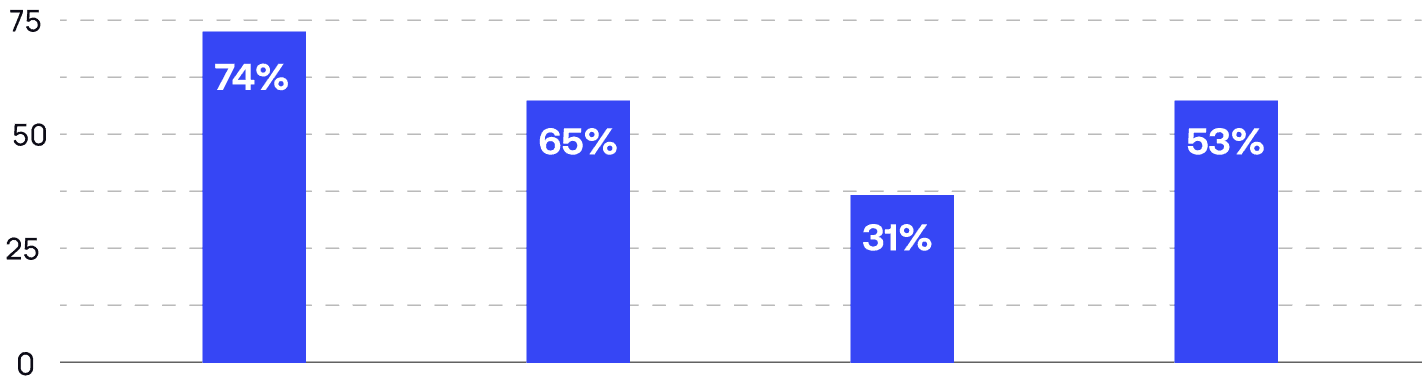
74%
74% of e-commerce leaders view AI as their primary 2026 driver.
65%
65% better service levels and 15% lower logistics costs reported by operators using self-correcting networks and intelligent routing.
31%
31% of IT budgets are consumed by "keeping the lights on" for legacy systems, hindering the transition to agentic AI.
53%
53% of total shipping expenditure is often accounted for by the last mile, making AI-driven optimization a financial necessity.
Artificial Intelligence:
Everything, Everywhere, All at Once
Artificial Intelligence (AI) is reshaping economic and commercial landscapes at an unprecedented pace. In 2025, 88% of organizations reported the regular use of AI in at least one business function, representing a 10-percentage-point increase from the year prior.2 The global market for AI solutions and AI-enabled systems surpassed $244 billion in 2025, nearly a fourfold jump compared to 2023. Market projections indicate that AI spending will continue to grow at a compound rate that places total market value beyond one trillion U.S. dollars within the next five years.12
Advances in machine learning architectures, cloud computing, and data availability have dramatically expanded the range of viable commercial applications. AI is now simultaneously transforming multiple industries13 – agriculture, education, healthcare, finance, entertainment, transportation, military, manufacturing, marketing, and more – marking what can be described as an "everything, everywhere, all at once" moment. Among these sectors, retail and e-commerce have emerged as some of the most fertile environments for AI adoption.

Traditionally, e-commerce analytics relied on batch processing and rule-based business intelligence systems to extract insights from customer behavior, transaction history, fulfillment data, and marketing performance.
While these approaches provided retrospective visibility, they were slow, rigid, and heavily dependent on manual configuration. Actionable insights often took weeks or months to emerge, delaying critical business decisions. As a result, companies frequently lost opportunities to respond to emerging trends and shifting consumer demand in real time.
Beyond latency, traditional analytics faced additional structural limitations. Insights were typically siloed by function, limiting cross-channel visibility and holistic decision-making. Rule-based systems struggled to adapt to novel patterns or rapidly changing conditions, particularly during demand shocks or seasonal volatility. As data volumes and complexity increased, these systems became progressively less effective at translating information into timely action.
With AI's capability to process complex data at speed and scale, these limitations are diminishing. AI systems convert large heterogeneous datasets (e.g., consumer behavior, transaction history, fulfillment data, and marketing performance) into actionable intelligence in real time. This has enabled proactive decision-making, continuous optimization, and adaptive responses that traditional analytical methods could not achieve at breadth or velocity.
As a result, AI has evolved from an experimental capability within e-commerce into a core infrastructure that underpins growth and differentiation. This shift represents the convergence of decades' worth of technological disruptions in computing, data analytics, and digital commerce.
The pace of AI adoption and investment observed in 2025, combined with its sustained momentum in the years leading up to it, makes it clear that AI will continue to act as a primary catalyst of change. For e-commerce, this marks the transition into a new era defined by intelligent automation and adaptive consumer experiences.
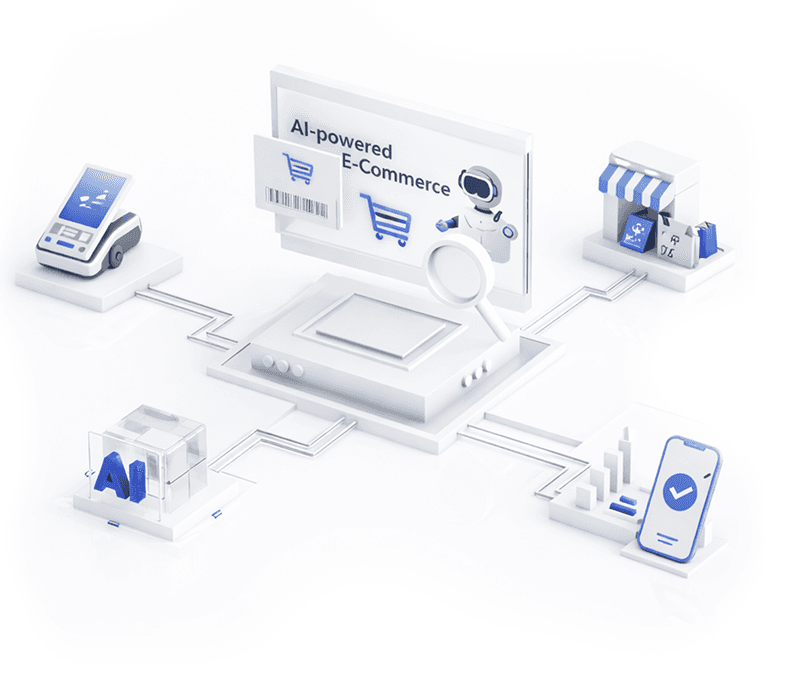
The Convergence of More Than A
Decade of Disruptions
The integration of AI into e-commerce has followed an evolutionary path, shaped both by consumer behavior and by the strategic priorities of brands. Early implementations were largely invisible to users, embedded in backend systems designed to improve efficiency rather than redefine the customer experience. Over time, AI became progressively more consumer-facing, culminating in today's agent-driven and conversational commerce models.
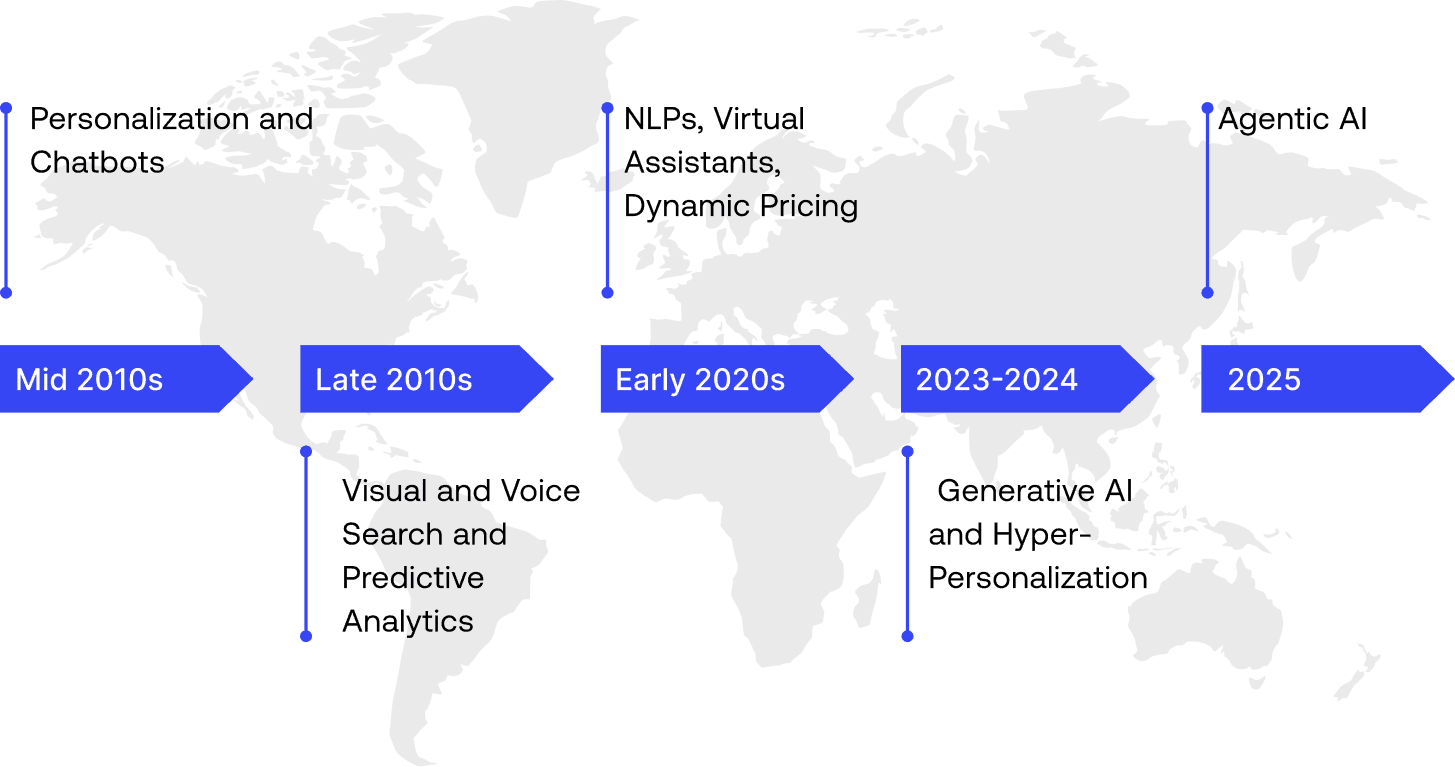
During this period, the most visible AI innovation in e-commerce centered on recommendation systems powered by early machine learning models.14 These systems analyzed customer browsing and purchase history to suggest products that aligned with individual interests. This capability moved personalization from manual merchandising to algorithmic decision-making.
Brands also began deploying chatbots with basic AI capabilities on messaging channels to support customer service and product discovery.15 Sephora's chatbot on Facebook Messenger, for example, provided tailored beauty advice and product recommendations, marking an early instance of conversational AI in commerce.16 This phase laid the foundation for consumer expectations of personalization and real-time online shopping guidance.
Visual search capabilities allowed consumers to search for products using images rather than text. Platforms such as Pinterest introduced visual search tools that enabled users to identify and shop for items directly from images.17 Retailers like ASOS and Wayfair adopted similar capabilities, enabling customers to upload photos and receive visually similar product recommendations.18
At the same time, voice search and voice-enabled commerce gained traction as smart speakers and digital assistants entered mainstream households. Amazon Alexa and Google Assistant enabled consumers to search for products, reorder essentials, and track deliveries using natural language.19 While early voice commerce volumes remained modest, these interactions reshaped expectations around convenience and immediacy. Voice interfaces pushed brands to rethink search optimization, product naming, and catalog structure to align with conversational behavior rather than keyword-based queries.
Retailers also increasingly used machine learning models to forecast demand, optimize inventory placement, and anticipate shifts in consumer behavior. These systems integrated historical sales data with external variables such as seasonality, promotions, and regional trends to improve accuracy and responsiveness.
The global COVID-19 pandemic accelerated e-commerce adoption and forced retailers to scale digital experiences rapidly. Advances in natural language processing (NLP) enabled virtual assistants capable of handling complex, multi-step interactions across the shopping journey.20 These systems absorbed surges in online demand while maintaining service continuity, effectively replacing capacity that could not be scaled through human labor alone.
During this period, AI-driven dynamic pricing models also became more widely adopted, allowing merchants to adjust prices in real time based on demand signals, inventory levels, competitor pricing, and customer behavior.21
The introduction of generative AI marked a structural shift in e-commerce capabilities. AI capabilities have expanded beyond analytics and optimization into content generation and advanced customer relationship management (CRM).22
This period also marked the rise of hyper-personalization.23 Unlike earlier recommendation systems that relied primarily on historical behavior, generative AI enabled dynamic experiences shaped by context, preferences, and real-time signals. Retailers leveraged these capabilities to personalize product assortments, messaging, and offers at the individual level across channels.
By 2025, AI in e-commerce entered the "agentic commerce" phase.24 Consumers began adopting general-purpose generative AI tools such as ChatGPT as an external shopping advisor that could synthesize and compare information across retailers, trends, reviews, and price points.25 AI systems began anticipating needs, planning multi-step tasks, and supporting users end-to-end from discovery through checkout and payment. Major retailers integrated generative AI platforms directly into their commerce stacks to enable contextual and multimodal shopping experiences.
Walmart's integration of ChatGPT into its digital storefront26 and Amazon's deployment of generative shopping assistants27 exemplified this shift. AI was no longer limited to surfacing options. It increasingly executed tasks on behalf of consumers with growing autonomy and contextual awareness.
More Than Hype
The pace of AI adoption is unprecedented when viewed through the lens of prior technological cycles. Historically, each major wave of innovation has compressed the time required to reach mass household adoption. Technologies associated with the 2nd industrial revolution took more than 4 decades to reach 50% penetration in U.S. households.
The personal computer (PC) era was approximately 20 years. Desktop internet adoption reached the same threshold in roughly 12 years, followed by the mobile internet era, which achieved mass adoption in 6 years.
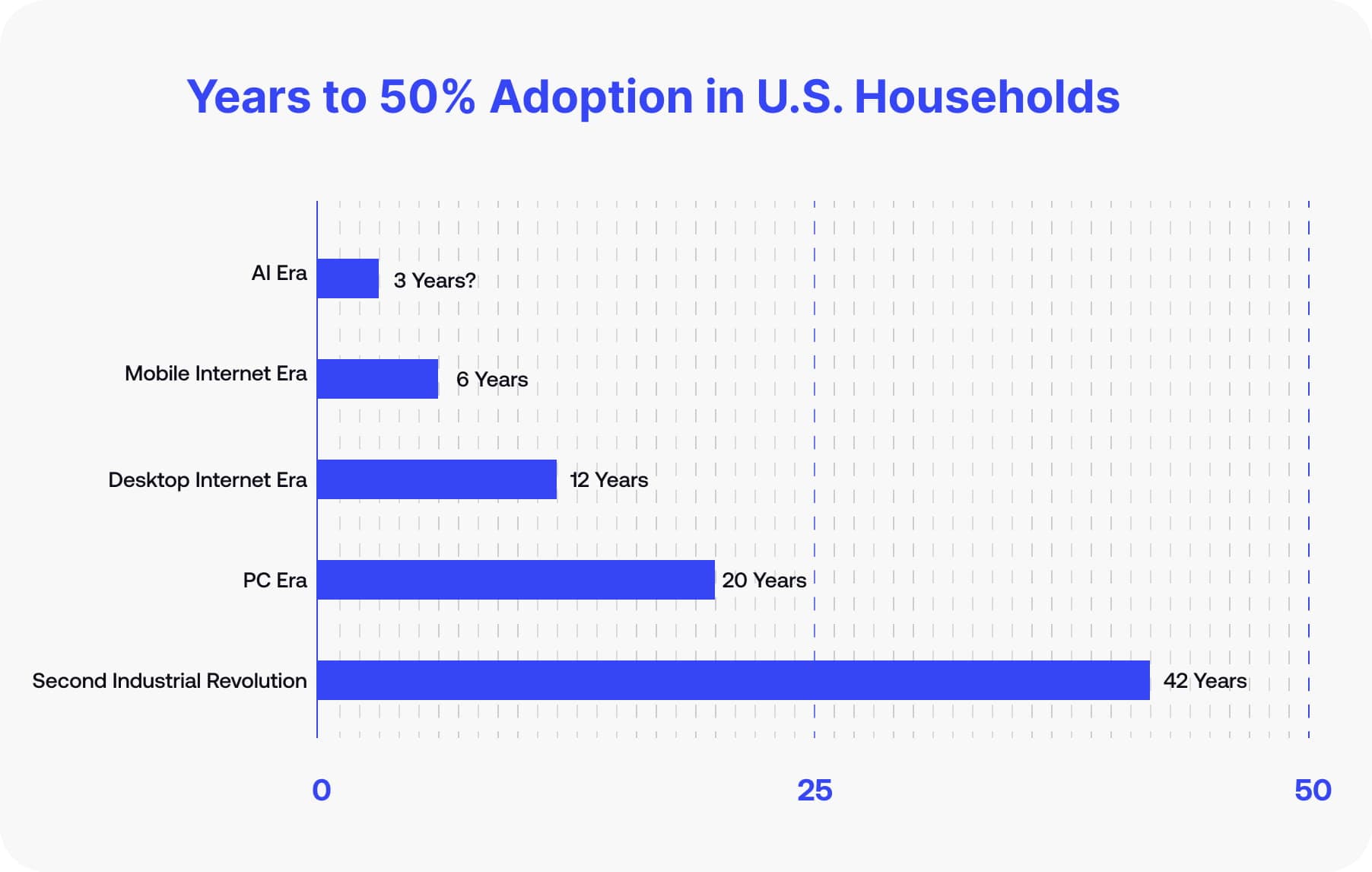
By comparison, the AI era has reached 50% penetration in U.S. households in just approximately 3 years—half the time to scale relative to the previous cycle.28
This trajectory stands in stark contrast to other recent technology waves that generated significant attention but struggled to achieve durable adoption. Technologies such as blockchain, cryptocurrency, and NFTs faced high barriers to entry. They required specialized knowledge, introduced unfamiliar mental models, and often demanded behavior changes without delivering immediate, everyday utility. Most importantly, they were not natively embedded into existing consumer platforms or workflows, limiting their ability to scale beyond early adopters.
AI differs fundamentally in these dimensions. It is intuitive to use, increasingly conversational, and deeply integrated into tools that consumers and businesses already rely on. Rather than asking users to learn new systems, AI adapts to existing behaviors, whether through search, messaging, productivity software, or commerce platforms.
This high-speed rate of adoption makes it increasingly clear that AI is not progressing through a prolonged experimentation or "hype" phase, but rather entering a period of rapid normalization. As AI continues to be woven into everyday experiences, from shopping and fulfillment to work and communication, its influence will only compound.

AI Will Only Accelerate E-Commerce
Adoption in 2026 and Beyond
AI is fundamentally reshaping digital commerce by making it easier, faster, increasingly personalized, and more intuitive. As AI-driven systems assume a greater share of discovery, comparison, and decision-making, a growing segment of consumers is demonstrating a clear willingness to trade autonomy for convenience.
Stord's recent AI sentiment survey found that 51% of consumers have used AI for online shopping, with 17% using AI tools regularly to help find the products they need. This represents approximately 135 to 140 million29 e-commerce consumers in the United States actively relying on AI in their shopping journeys today.
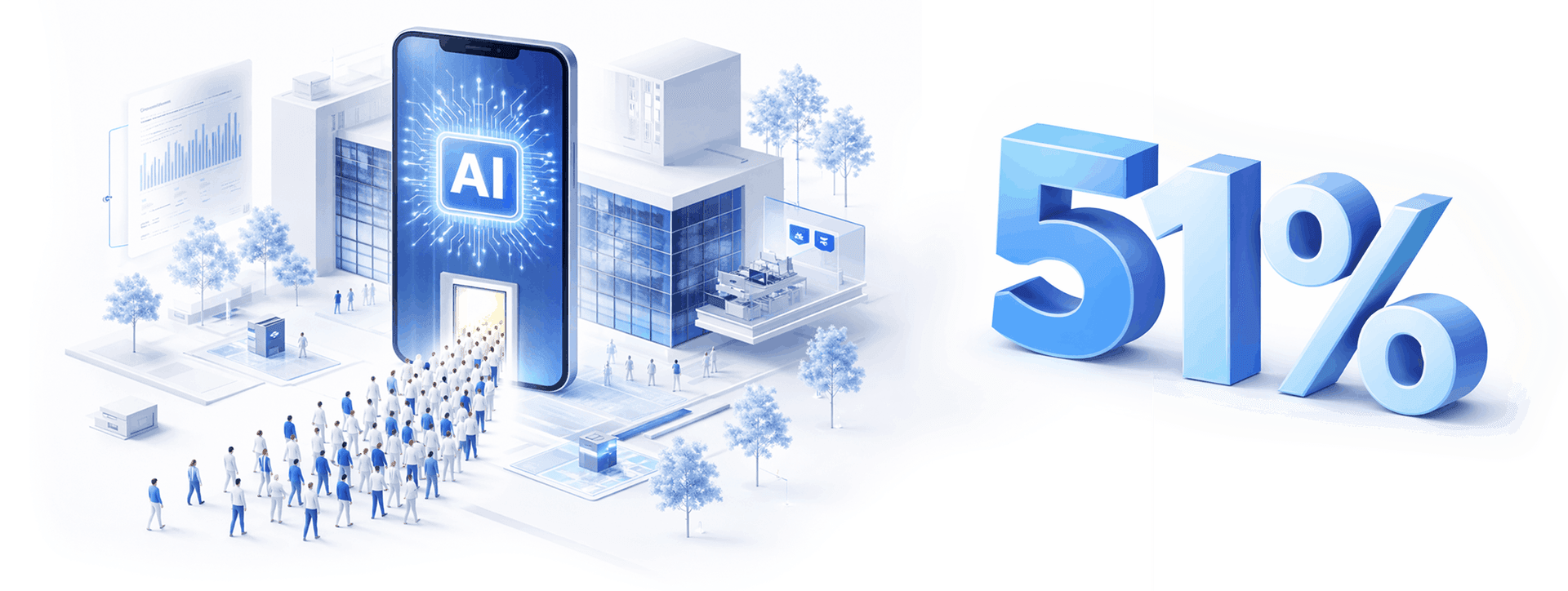
of consumers use AI for online shopping translating
to approximately 135 to 140 million U.S. consumers
Despite ongoing public discourse that frames AI as existing within a hype bubble, the data suggests that a meaningful share of consumers is already translating this interest into sustained repeat behavior. This willingness to adopt mirrors earlier inflection points in e-commerce.
Consumer demand for faster and more predictable e-commerce experiences drove two-day and same-day shipping to become standards in fulfillment, alongside real-time tracking that eliminated uncertainty around delivery timing. In each case, adoption accelerated because these capabilities removed friction from the customer journey.
In that same sense, consumers have found that delegating tasks to AI reduces the cognitive load required to shop, making product research, comparison, and decision-making materially more efficient. Stord's Mystery Shopping Report made it clear that consumers consistently want experiences that are easier, faster, better, and cheaper.
AI has emerged as a tool that directly addresses these priorities. Just as e-commerce once differentiated itself from brick-and-mortar retail through convenience and accessibility, AI-assisted shopping is now extending that same value proposition within digital commerce itself.
For e-commerce brands, this creates a clear precedent. AI is already influencing how demand is shaped, how products are discovered, and how value is captured across the e-commerce ecosystem. Failing to engage with this shift risks ceding relevance with a growing segment of the market.
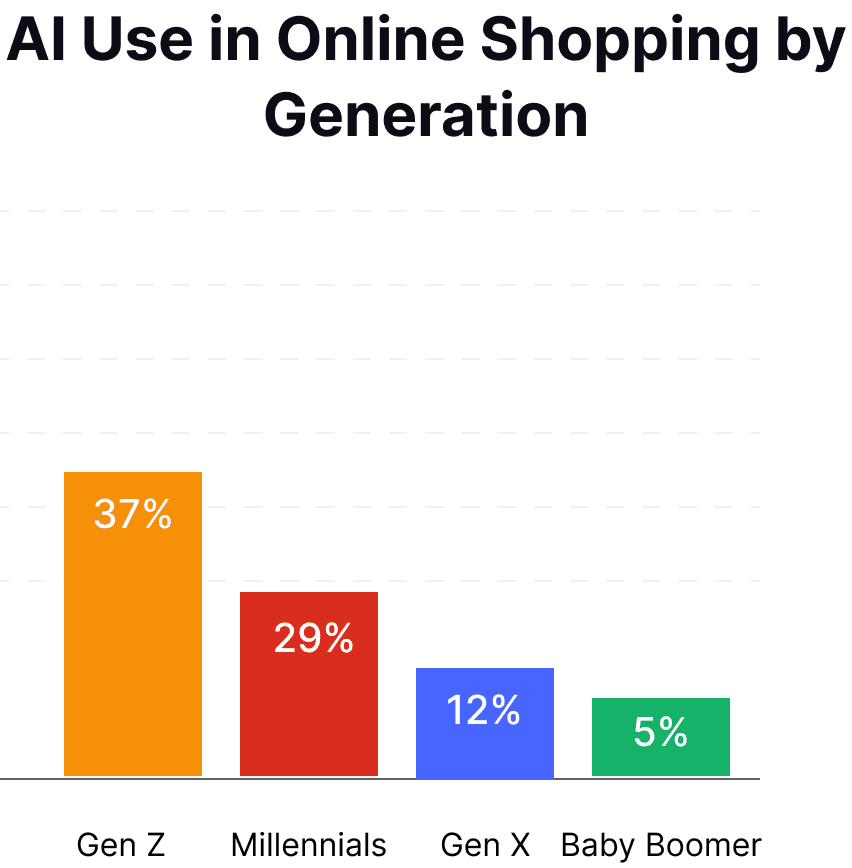
Adoption, however, varies considerably between generations. Among Gen Z consumers, 37% actively use AI to aid in their online shopping experiences, followed by Millennials at 29%.
In contrast, adoption remains limited among Gen X at 12% and Baby Boomers at 5%. AI-assisted commerce is becoming a default behavior for younger cohorts while remaining peripheral for older generations.
The underlying drivers of this divide are structural rather than transient. Older consumers tend to place a higher premium on control, transparency, and familiarity, having developed shopping habits in an environment where digital tools were additive. Concerns around trust, data privacy, and perceived loss of agency further dampen adoption.
In fact, our survey found that 50% of Baby Boomers are not interested in using AI for shopping at all, notably citing their distrust of AI recommendations or giving any AI tools their personal information. By contrast, younger cohorts have grown up in a technology-saturated environment defined by mobile-first experiences. For these consumers, AI is not a novel interface but a natural extension of how they already search, evaluate, and transact. Their higher comfort with AI delegation reflects habitual reliance on digital intermediaries in exchange for speed, convenience, and relevance.
While Baby Boomers have been more reluctant to adopt AI-enabled shopping tools, they remain a critical economic segment that cannot be deprioritized. During the most recent BFCM period, Facteus data revealed that Baby Boomers drove the highest absolute retail spend at $13.21 billion, underscoring their continued importance to revenue growth.
However, this dominance is unlikely to persist indefinitely. While Baby Boomers currently command the largest share of absolute retail spend, their relative influence will wane over time as demographic and economic dynamics shift. Younger cohorts are rapidly expanding their purchasing power and reshaping consumption patterns in ways that favor digital and AI-mediated commerce. A recent consumer spending report projects that Gen Z will represent the fastest growing segment in global spending power, reaching an estimated $12 trillion by 2030 and overtaking Baby Boomer spending as early as 2029.30
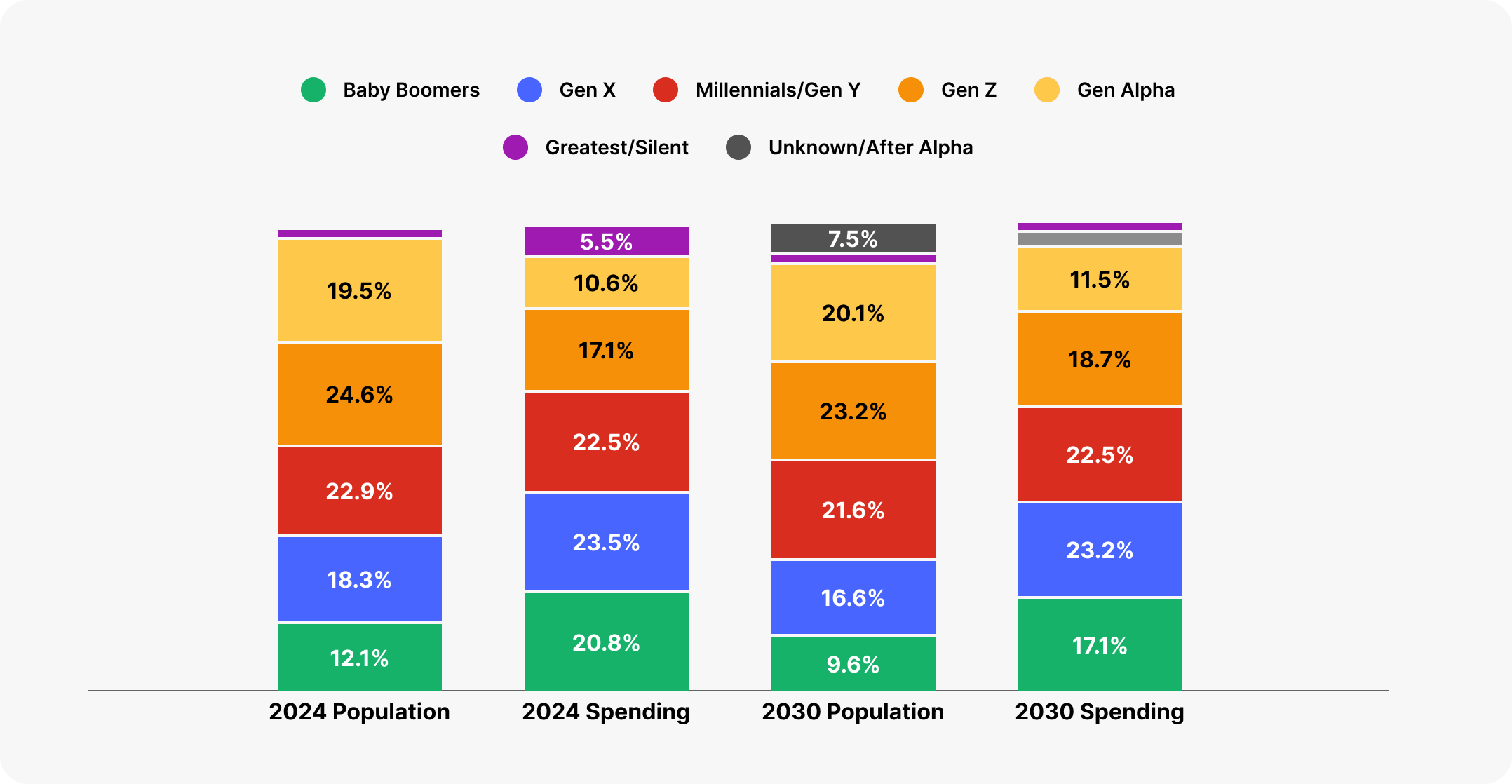
For brands, this creates a dual-track strategic imperative. In the near term, they must continue to serve Baby Boomers effectively, recognizing their outsized contribution to revenue and their distinct expectations around trust, clarity, and control.
At the same time, they must prepare for a future in which growth is increasingly driven by younger consumers whose default mode of engagement assumes AI assistance, personalization, and convenience. The brands that succeed will be those that manage this generational handoff deliberately, using AI not only to capture emerging demand, but also to adapt experiences across cohorts without alienating legacy demand.
One Small Prompt for Humans,
One Giant Leap for E-Commerce

Training an AI system to understand an individual's shopping preferences, habits, and constraints requires meaningful upfront investment from the consumer. Preferences must be articulated, permissions granted, and behavioral patterns established over time. Once in place, however, the marginal effort required from the consumer declines sharply.
The result is a step change in efficiency where routine purchasing shifts from an active task to a largely automated process. This dynamic is accelerating a broader move toward AI delegation, which is expected to culminate in a zero-click buying era,31 where consumers purchase products without having to click a "buy" button or leave their agentic commerce app of choice.
In the conventional model, consumers independently manage discovery, comparison, evaluation, and execution, ultimately introducing friction to each stage in the buying journey.
Conventional Online Shopping

Consumer realizes a need and starts their search

Consumer researches and compares products based on specifications, price, deals, quality, and reviews (low-value purchases ≈10-60mins; high-value purchases ≈ days or weeks)

Consumer chooses a product and proceeds to checkout

Consumer fills out checkout information: name, contact information, ship-to address, billing address, payment details, delivery service level, and courier

Consumer tracks order status and manages post-purchase actions (e.g., WISMO inquiries, returns)
Agentic Commerce and Zero-Click Buying

Consumer asks the AI agent a shopping question

AI agent finds and selects the best options based on the prompt and provides a detailed breakdown of each in terms of specifications, price, deals, quality, and reviews

Consumer scans the short list of curated product options surfaced within the chat interface and decides on the product (research and decision-making effectively reduced from hours or days to seconds)

AI agent completes the transaction (if product supports instant checkout) and handles everything from checkout to payment

AI agent tracks the order, provides updates, and if necessary, handles follow-ups and returns
The time it takes for shoppers to research and decide on a product is dependent on the assigned value of the purchase being made. Low-value purchases can span from a few minutes to an hour. But high-value purchases can take up to days or weeks.32 Moreover, two-thirds of consumers expect to finish online checkout in 4 minutes or less.33 And our recent Stord survey found that 24% will abandon their online carts if the checkout process becomes too long or complex.
Abandoned Cart Recovery Calculator
Up to 24% of consumers abandon their online carts if the checkout process is too long or complex. See how much a 5-10% improvement with AI-powered frictionless checkouts can potentially help your brand earn more.
Agentic commerce compresses the conventional online shopping journey by removing several of its most time- and attention-intensive steps. Agentic systems collapse these stages, and what remains for the consumer is simply a moment of validation rather than a sequence of decisions.
Search and comparison, which often account for the majority of time spent in a shopping session, are effectively eliminated as explicit consumer actions. In an agentic world, online shoppers only need to create the prompt, wait for the recommendations (which often take only a matter of seconds), and then choose the product they like best.
Once a purchase is made, the AI agent continues to operate on the consumer`s behalf throughout the post-purchase journey. By integrating real-time order, carrier, and inventory data, AI systems can generate more accurate estimated delivery dates (EDD) that continuously update as conditions change. Rather than relying on static delivery windows, the agent monitors shipment progress, anticipates potential disruptions, and proactively communicates status updates. If delays occur, the agent can explain the cause, present revised timelines, and initiate corrective actions without requiring the consumer to intervene. In cases where a return, exchange, or follow-up is necessary, the agent can guide or execute the process end-to-end.
For consumers, this model fundamentally changes the experience after checkout. Fewer surprises, clearer and more timely communication, and a sense that the order is being actively managed on their behalf replace the uncertainty that has historically characterized e-commerce fulfillment. The cognitive burden of tracking orders, following up with support, or navigating returns is substantially reduced. As a result, the shopping journey feels more continuous and coherent, extending the convenience of agentic discovery into fulfillment and service.
This effectively reduces the often 5-step (or more) conventional online shopping experience to a frictionless 2-step prompt-and-select process.
Tip from the Stord Collective: Parabola

As a result of AI tooling, end consumers will receive higher-quality experiences with virtually every brand they purchase from — not just Amazon.
Historically, only brands with meaningful engineering resources could deliver that "white glove" post-purchase experience: accurate tracking, proactive updates, and fast issue resolution.
AI is making that level of reliability accessible to smaller, scrappier brands too. It helps brands catch issues earlier, keep customers informed automatically, and prevent delays from turning into frustration. Net effect: fewer surprises, better communication, and a smoother experience across the board.
Return On Intelligence
When purchasing no longer requires extended consideration, the psychological threshold to complete a transaction declines. As a result, consumers are more likely to act on latent needs, replenish products earlier than planned, and accept recommendations for adjacent or complementary categories.
Our survey found that 20% of consumers are more likely to complete a purchase when a product or online store is recommended by AI. However, this uplift in conversion is not evenly distributed across generations. Gen Z exhibits the highest likelihood to convert following an AI recommendation at 38%, followed closely by Millennials at 34%. Conversion propensity declines among older cohorts, with Gen X at 15% and Baby Boomers at just 7%.
In practical terms, this means that every time a consumer engages with an AI assistant or AI-powered search tool and a brand is surfaced as a recommendation, that brand benefits from a structurally higher probability of conversion. As younger cohorts continue to account for a growing share of incremental spending, the compounding effect of AI-driven discovery on conversion rates becomes increasingly material.

How AI Recommendations Can Help Your Brand
If you can increase the number of your products recognized by AI-powered tools, your brand stands to capture more conversions than competitors who don't.
Baby Boomer Customers
- $0Incremental Annual Revenue
- 0Incremental Annual New Orders
Gen X Customers
- $0Incremental Annual Revenue
- 0Incremental Annual New Orders
Millennial Customers
- $0Incremental Annual Revenue
- 0Incremental Annual New Orders
Gen Z Customers
- $0Incremental Annual Revenue
- 0Incremental Annual New Orders
As AI assumes responsibility for narrowing options, recommendations carry greater weight and move closer to the point of action. Over time, this dynamic is expected to increase purchase frequency by compressing the online shopping decision cycle. Instead of episodic, high-effort shopping sessions, transactions become more continuous and embedded in daily routines, thereby reinforcing a loop that drives higher online shopping volumes.
Beyond product search, agentic commerce is also reshaping price discovery. AI-powered assistants can now scan a broad universe of online retailers, promotions, and historical pricing in seconds, surfacing relevant deals that would have previously required significant time and effort.
As a result, consumers are not only buying more frequently but also buying more confidently, with greater assurance that they are purchasing products at competitive prices. In fact, our survey found that in 2025, 17% of consumers who used AI tools for online shopping reported finding better deals and discounts. And this behavior appears poised to accelerate, with 20% expressing interest in trying AI-enabled shopping tools in 2026 to secure better value for their money.
Tip from the Stord Collective: Taxually

AI will make shopping more personal and efficient. Consumers will interact with AI agents that recommend products, answer questions, and even complete purchases.
For cross‑border e‑commerce, AI‑powered tax engines will ensure that customers pay the correct VAT/GST at checkout and that compliance is automated.
Taxually's platform uses machine learning to validate and correct transaction data, processing 40,000 tax calculations per minute while keeping calculations up‑to‑date. This real‑time accuracy reduces surprise tax bills and builds trust.
AI and machine learning, when used in tax audits to identify discrepancies and detect fraud, can ensure that consumers face fewer compliance headaches when purchasing internationally.

Commerce, On Autopilot
In a future that's fully integrated and dominated by AI technology, an AI agent could, for example, detect low inventory through a refrigerator or pantry sensor and either notify the consumer or automatically reorder items based on budget, brand, and timing preferences. There will come a point where we are no longer active participants in the e-commerce experience having given up authorship for efficiency and convenience. And this comes with significant trade-offs.
Trust, privacy, and security, for instance, remain a critical concern. As AI assumes a more active role in decision-making, the balance between convenience and autonomy becomes increasingly delicate. Our survey data found that while 16% of consumers report being very comfortable allowing AI to complete purchases and use their payment information if it saves them money, and another 21% are open to AI-assisted shopping provided they can review transactions first, nearly one-third of consumers (30%) say they would never allow AI to handle shopping or access their payment details.

As AI adoption continues to accelerate in 2026, the future of e-commerce may be less about full automation versus human control, and more about striking the right balance between the two, that is, unlocking the full potential of agentic commerce without alienating the very consumers it aims to serve.
Hyper-Personalized Shopping Experiences
Beyond AI-assisted shopping, agentic commerce, and zero-click buying, another powerful force accelerating e-commerce adoption is hyper-personalization. While automation reduces friction and effort, hyper-personalization increases relevance and emotional resonance. Together, these forces reshape not only how consumers buy, but how brands build lasting customer relationships.
Hyper-personalization refers to the use of real-time data, behavioral signals, and AI-driven intelligence to tailor experiences at the individual level.
This goes well beyond traditional personalization approaches that predated AI. Historically, personalization in e-commerce relied on broad segmentation and static if/then customization.
Customers might receive an email addressed by first name, see generic product recommendations based on past purchases, or be grouped into coarse segments such as new versus returning customers.
These approaches improved relevance incrementally, but they remained limited in scope, slow to adapt, and often disconnected across channels.
With advanced machine learning and generative capabilities, hyper-personalized experiences become shaped not only by what a customer has done, but by when, why, and how they are likely to act next. For example, rather than recommending products based solely on category affinity, AI systems can adjust recommendations in real time based on intent signals, lifecycle stage, location, and even external context (e.g., climate, season, trends).
Buy It Right The First Time
These AI-powered hyper-personalized experiences have also fundamentally reshaped the pre-purchase stage of e-commerce.
Prior to AI, product discovery was largely linear and reactive. Shoppers relied on keyword-based search, static category pages, bestseller lists, and broad rule-based recommendations such as "customers also bought." Personalization existed, but it was typically anchored to a narrow set of signals, most often past purchases or high-level browsing behavior.
A returning customer might see recently viewed items or generic cross-sell suggestions, but discovery still required significant manual effort.
pre-AI recommendations
AI-powered hyper-personalized recommendations
Today, AI has inverted this dynamic. Product discovery is increasingly predictive, contextual, and adaptive. Recommendations are no longer based solely on historical transaction data, but on a far richer constellation of signals that include real-time browsing intent, inferred preferences, seasonality, location, social trends, and even conversational inputs. AI-powered systems can surface products based on how a shopper describes an occasion, a mood, or a problem they are trying to solve.
For example, a consumer browsing for a "summer wedding outfit" may receive recommendations that account for climate, dress code, past brand affinity, body type indicators, and price sensitivity, rather than simply being shown dresses sorted by popularity.
These hyper-personalized recommendations have also improved the accuracy of what customers buy online, particularly in categories where fit, size, and style are historically difficult to assess. Some apparel and footwear brands are already using AI-driven sizing and fit engines that incorporate body data, return history, peer comparisons, and product-specific attributes to recommend the most likely size for each individual shopper. Brands like Levi's have deployed fit recommendation tools that reduce uncertainty and increase buyer confidence, especially for first-time purchases.
In categories such as health and beauty, AI systems can recommend products based on a customer's purchase history, stated preferences, lifestyle indicators, and usage patterns, while also incorporating insights from cohorts of consumers with similar profiles. For example, skincare recommendations can be tailored based on skin type, climate, ingredient sensitivities, and outcomes reported by comparable users, rather than relying on generic product claims or influencer content. This shifts decision-making from trial-and-error to informed, personalized guidance.
Moreover, the same intelligence that powers hyper-personalized discovery and fit accuracy can also be applied upstream to inventory planning and fulfillment. By understanding customer preferences, size distributions, regional demand patterns, and climate-driven consumption behaviors, AI models can forecast which SKUs are most likely to convert in specific regions. This enables brands to stock the most relevant products in the warehouses and fulfillment centers closest to anticipated demand.
Tip from the Stord Collective: Moselle

Consumers don't think about inventory, they feel it when brands get it wrong. Stockouts of their favourite products, unexpected backorder waits or over-discounted products that were overbought.
AI-driven demand planning changes this. It means consumers get what they want, when they want it, more consistently.
The invisible infrastructure of commerce gets smarter. Moselle has helped brands like Fable increase forecast accuracy by 16%, which translates directly to better product availability and fewer disappointed customers.
For brands using AI forecasting, the positive impact is fewer "sold out" disappointments and less of the frantic discounting that erodes trust. The consumer experience becomes more seamless because of the AI intelligence working behind the scenes.
As a result, AI-recommended purchases are increasingly associated not only with higher conversion rates but also with lower return rates. Multiple case studies indicate that personalization driven by AI improves purchase confidence and alignment between expectations and actual product outcomes.
While the magnitude of return reduction varies by category, brand, and product type, the directional impact is consistent. For example, & Other Stories, a fashion brand owned by the H&M Group, reported a 32% reduction in return rates after deploying a combination of AI-powered fit recommendations and interactive three-dimensional product guides for its knitwear assortment.35
Returns have been a persistent structural challenge for e-commerce brands. In 2025, total retail returns were estimated to reach approximately $850 billion, with roughly 9% attributed to fraudulent returns.36 For every dollar of fraudulent return, retailers lose an average of $4.61.37 For brands, this scale of returns erodes margins through reverse logistics costs, inventory depreciation, labor expenses, and lost resale value.
Returns Fraud Cost Savings Calculator
Even just a 5% improvement in meeting customer product expectations through AI-powered hyper-personalized recommendations can result in massive value. Calculate your potential savings.
By ensuring that customers buy products that better match their needs upfront, hyper-personalized recommendations reduce the likelihood of dissatisfaction after delivery. Rather than managing returns as a downstream cost, AI enables brands to prevent them at the source, improving unit economics while delivering a better customer experience.
Where Digital Meets Physical
Another capability that makes AI-driven hyper-personalization especially impactful is that it is no longer confined to digital interfaces alone. While much of the focus has been on websites, apps, and conversational agents, AI also enables hyper-personalization to extend into the physical dimension of e-commerce, particularly evident in the unboxing experience.
Unboxing is the only marketing channel with a near guaranteed 100% open rate.
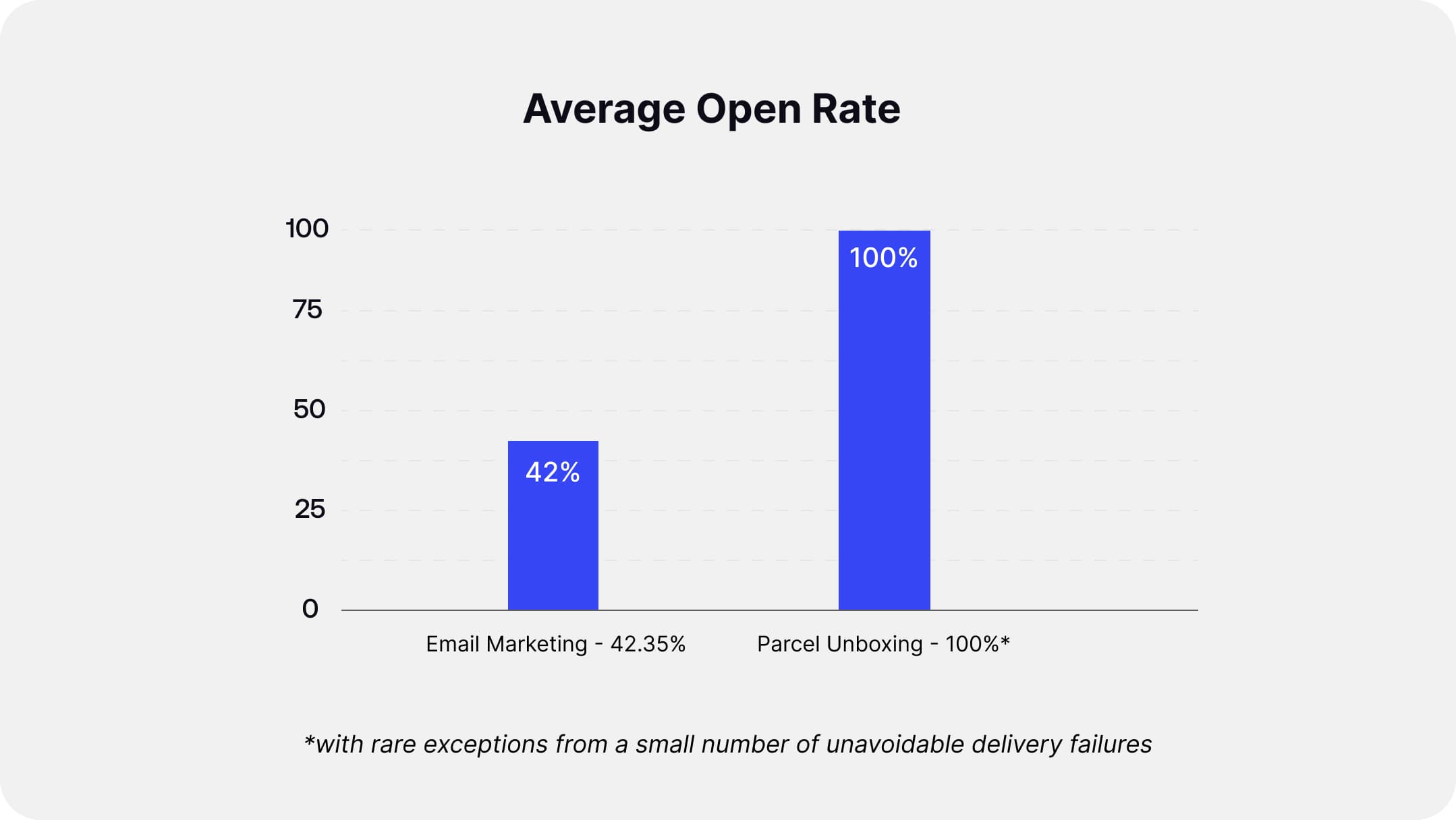
Historically, this moment has been underleveraged due to operational complexity. Customized branded inserts are expensive and difficult to execute at scale.
Unlike digital campaigns that can be launched by a single marketer using CRM platforms, physical inserts require coordination across and between departments and teams (e.g., marketing, sales, operations, warehouse teams). As a result, brands have long faced a trade-off between scale and personalization.

AI changes this equation. Its ability to link customer data across sales channels, CRMs, and order management systems enables hyper-personalized branded inserts at scale. For consumers, this translates into a more coherent and meaningful e-commerce experience where the digital journey is reinforced by the physical, tangible experience of receiving the product.
When personalization extends beyond the screen and manifests in the moment of delivery, e-commerce begins to replicate and, in some cases, surpass the emotional resonance often associated with in-store experiences. And as these experiences compound over time, consumers grow more comfortable shifting an even greater share of their purchasing behavior online.
The reassurance that digital interactions will translate into relevant, thoughtfully designed physical experiences reduces hesitation around repeat purchases, higher value items, and new categories.
In this sense, AI-assisted online shopping, agentic commerce, and hyper-personalization act as demand multipliers. They increase conversion, deepen loyalty, and raise lifetime value, all while lowering the psychological barriers that once constrained e-commerce growth.

The AI Advantage for Modern Brands
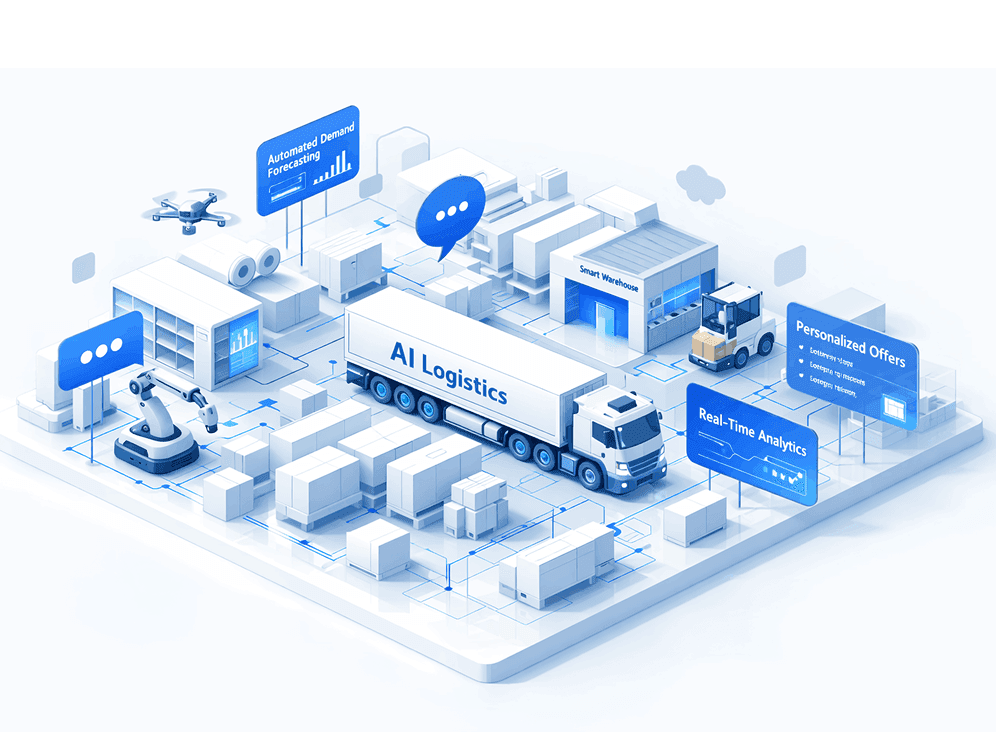
In 2026, the baseline for e-commerce has moved past surface-level experimentation.
Brands have transitioned from using generative tools for basic tasks, such as product descriptions, to achieving full agentic integration.
The power of modern AI lies in its ability to drive tangible business outcomes without constant human intervention.
For instance, an agentic merchant no longer waits for manual reviews of weekly sales reports to identify a downturn. Instead, the system autonomously identifies high-intent segments of at-risk customers, creates personalized bundle offers based on nuanced browsing histories, and adjusts real-time pricing to protect margins. This occurs while simultaneously synchronizing with the warehouse to ensure operations and fulfillment is prepared for the resulting demand spike.
As established in our analysis of shifting consumer sentiment, shoppers now expect a level of proactive utility that only deeply integrated AI systems can provide. This demand has fueled an aggressive industry-wide transformation. Since early 2025, the share of brands integrating AI into core functions has climbed into a vast majority, representing a 10-percentage-point increase in a single year.
These retailers are already realizing the financial dividends of this transition. Early adopters leading in AI-driven personalization are achieving up to 40% higher revenue than their non-AI counterparts.4 Furthermore, 95% of retailers report that AI implementation is actively helping decrease annual operating costs.38
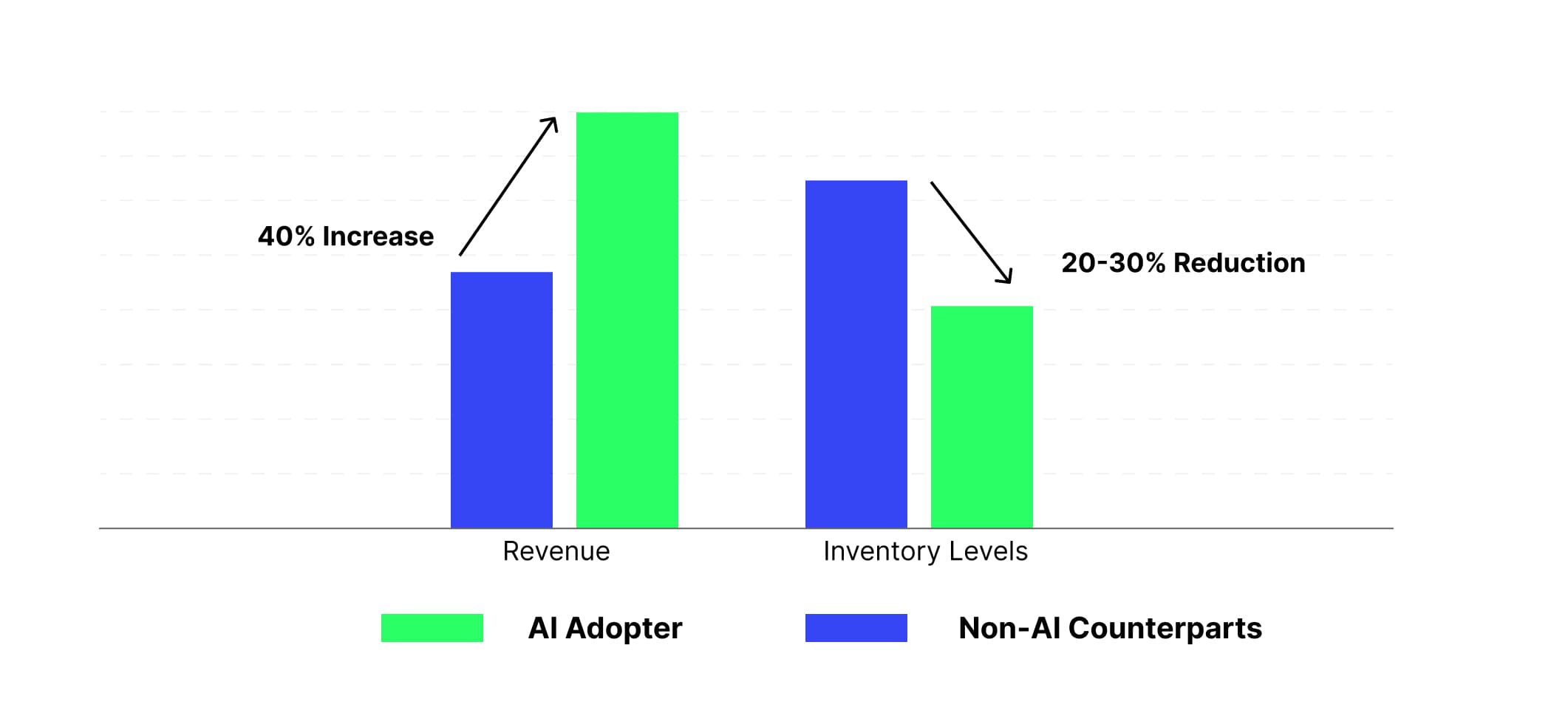
The impact on inventory health is particularly significant. Effective AI implementation, driven by machine learning models that enhance demand forecasting and dynamic segmentation, allows operators to maintain leaner stock profiles without compromising availability.
These predictive demand models have led to a 20% to 30% reduction in inventory levels for leading organizations.39 While these backend efficiencies create a more resilient commerce and fulfillment network, the transition to a fully autonomous brand experience hinges on overcoming a critical psychological barrier. This friction reflects a persistent gap between what algorithms are technically capable of executing and the level of autonomy that consumers are currently willing to grant them.
While brands move toward agentic systems that adjust pricing and offers in real-time, a substantial portion of the market remains wary of delegating financial control to an algorithm. Consumers are concerned with the security of payment information and the lack of transparency in automated decision-making.
To address this, forward-thinking brands are moving away from opaque automation in favor of contextual communication. Rather than letting a system quietly adjust an offer, brands now explicitly justify those adjustments to the user by framing a discount as a "localized inventory clearance." This transparency serves as a viable bridge for skeptical cohorts, specifically Baby Boomers, who currently view AI recommendations with high levels of distrust.
The successful e-commerce brands of 2026 are no longer defined by their ability to react to the market but by their capacity to pre-empt it. This evolution is an active requirement driven by the end of traditional search and manual management. We expect the market to consolidate around three shifts in brand behavior:
- From Clicks to Conversational Intent: Brands must transition from optimizing for search engine clicks to earning trust from the AI agents that now act as proxies for the consumer.
- From Human-Led to Agent-Augmented: The most efficient brands are no longer adding headcount to scale but are deploying computational labor or specialized AI agents that autonomously manage pricing, demand, ad creative, and more.
- From Reactive to Prescriptive: Rather than waiting for sales reports, brands use sense-and-respond infrastructure to predict micro-trends. Retailers leading this charge achieve substantial revenue lifts by delivering hyper-personalization.
In a market of AI dominance, the brand is increasingly evaluated by an algorithm. To maintain an advantage, organizations must make their products agent-discoverable while doubling down on the one thing AI cannot replicate, which is the physical reality and reliability of the product in the customer`s hands.
Are Brands Leveraging AI Effectively?
The short answer is no—not yet.
The acceleration of AI-driven e-commerce introduces execution challenges. Legacy systems, fragmented data architectures, and organizational silos limit the effectiveness of AI deployments.
While investment in AI is nearly universal, the depth of that integration remains shallow for the vast majority of organizations. Data shows that while 92% of companies plan to increase their AI investments, 99% of organizations still lack a mature framework for full integration.3 This disparity reveals a critical gap where ambition often outpaces execution. Additionally, the cost of implementation and the scarcity of specialized talent create asymmetries between large incumbents and smaller players.
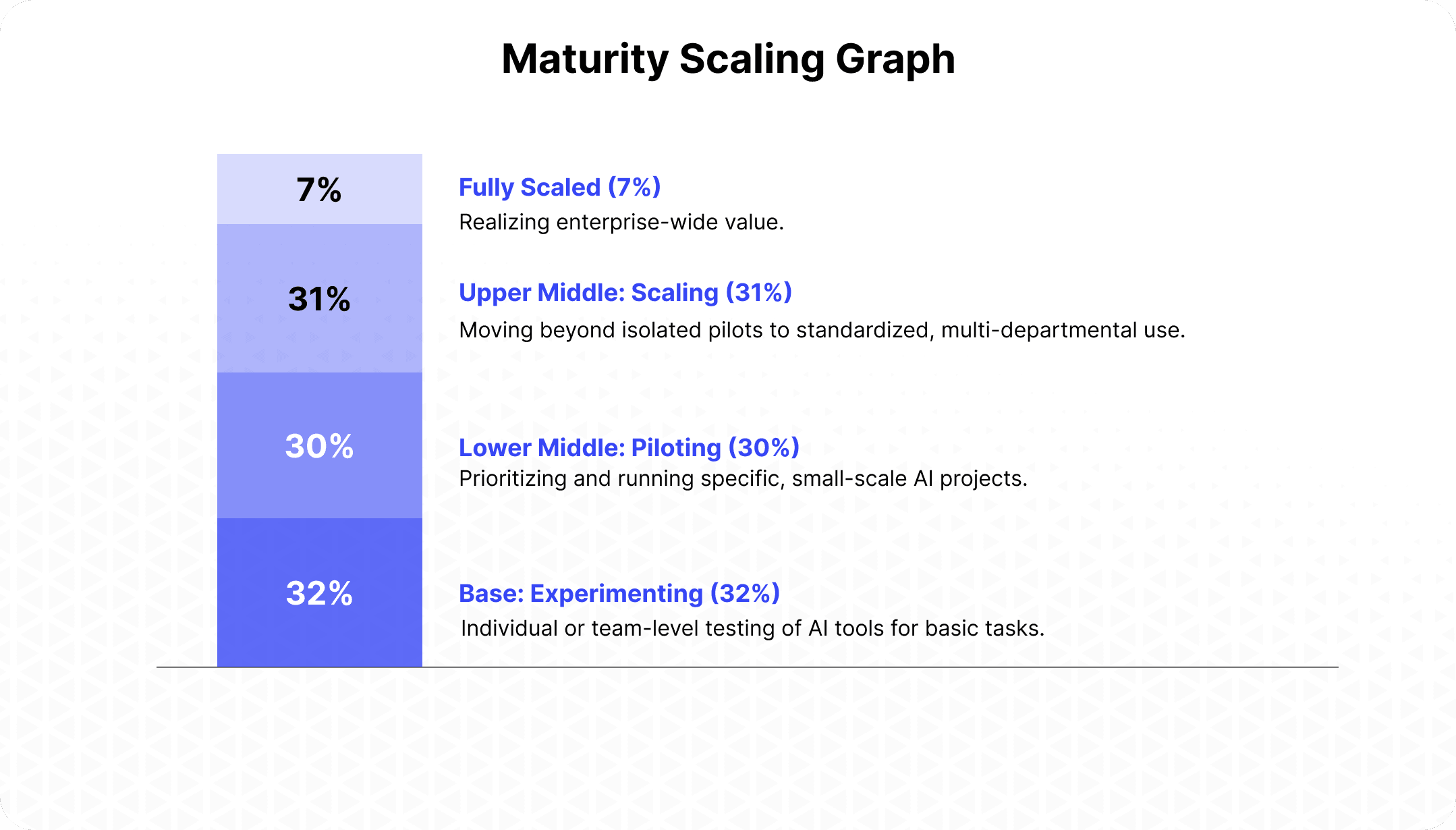
While leading platforms can absorb experimentation and infrastructure investment, many organizations face significant trade-offs between ambition and feasibility. The latest data reveals that while AI use is now nearly universal, its depth remains remarkably shallow. Currently, only 7% of organizations have reached the fully scaled stage,2 where AI is integrated deeply enough to drive material enterprise-level benefits.
The vast majority is still navigating the early stages of the journey. Approximately 32% of organizations are in the experimentation phase, with another 30% stuck in the piloting stage, testing isolated use cases without broader integration. While 31% have begun the process of scaling their AI programs, they have yet to reach full maturity.2 This disparity, where only a small fraction of the regular users has achieved enterprise-wide impact, suggests that the gap between digital intent and physical execution remains the primary hurdle for the industry.
This execution gap is as much about digital integrity as it is about technical infrastructure. While the vast majority of leaders have integrated AI into their workflows, many have yet to solve for the accuracy issues that destroy customer loyalty. For the segments of the market that remain highly sensitive to security and privacy, a shallow or hallucinating AI integration reinforces their established fears. Complete transformation requires that a system can justify its decisions and remain grounded in factual reality.
The gap between using AI and scaling AI is where the most risks lie for brands. Staying ahead requires more than just applying general-purpose AI tools onto legacy problems. A structural shift toward e-commerce-specific AI toolsets that understand the nuances of the brand value chain is necessary. Success in this prescriptive market depends on moving beyond shallow trial-and-error and identifying the right infrastructure partners who can bridge the gap between digital intent and physical execution.
Brands attempting to build agentic workflows on top of fragmented architectures frequently remain trapped in isolated testing phases. Transitioning to an AI-native ecosystem that unifies order management, inventory visibility, and fulfillment intelligence is a structural necessity for deploying a scalable digital workforce. For instance, the Stord One Commerce framework moves a brand toward a fully integrated model. This transition serves as the dividing line between reactive brands and those capable of leading in an AI-first market.
Better AI Integration Across the Brand Value Chain
To fulfill the promise of a modern brand, AI must be treated as a unified architecture across three critical pillars: Marketing, Product, and Demand. Leading brands are moving away from siloed tools in favor of an integrated engine that turns digital intent into physical reality.
Marketing and the Rise of Machine-Readability
As personal AI agents evolve into the primary intermediaries of the shopping journey, the first impression of a brand has shifted from a visual encounter on a screen to a technical encounter in a database. As brands shift from competing for human attention to optimizing for agentic discovery, they must ensure their products are not only visible, but also legible and interpretable to the machines increasingly acting as proxies for consumer decision making.
This change has resulted in Answer Engine Optimization (AEO). Unlike traditional Search Engine Optimization (SEO), which focuses on keywords and backlinks to drive a human to a website, AEO is designed to provide an AI agent with structured, verifiable facts that it can ingest and recommend as the definitive "absolute answer." In this new frontier, a brand's goal is no longer a high ranking on a search page, but a high inclusion rate within an AI system's recommendation logic.
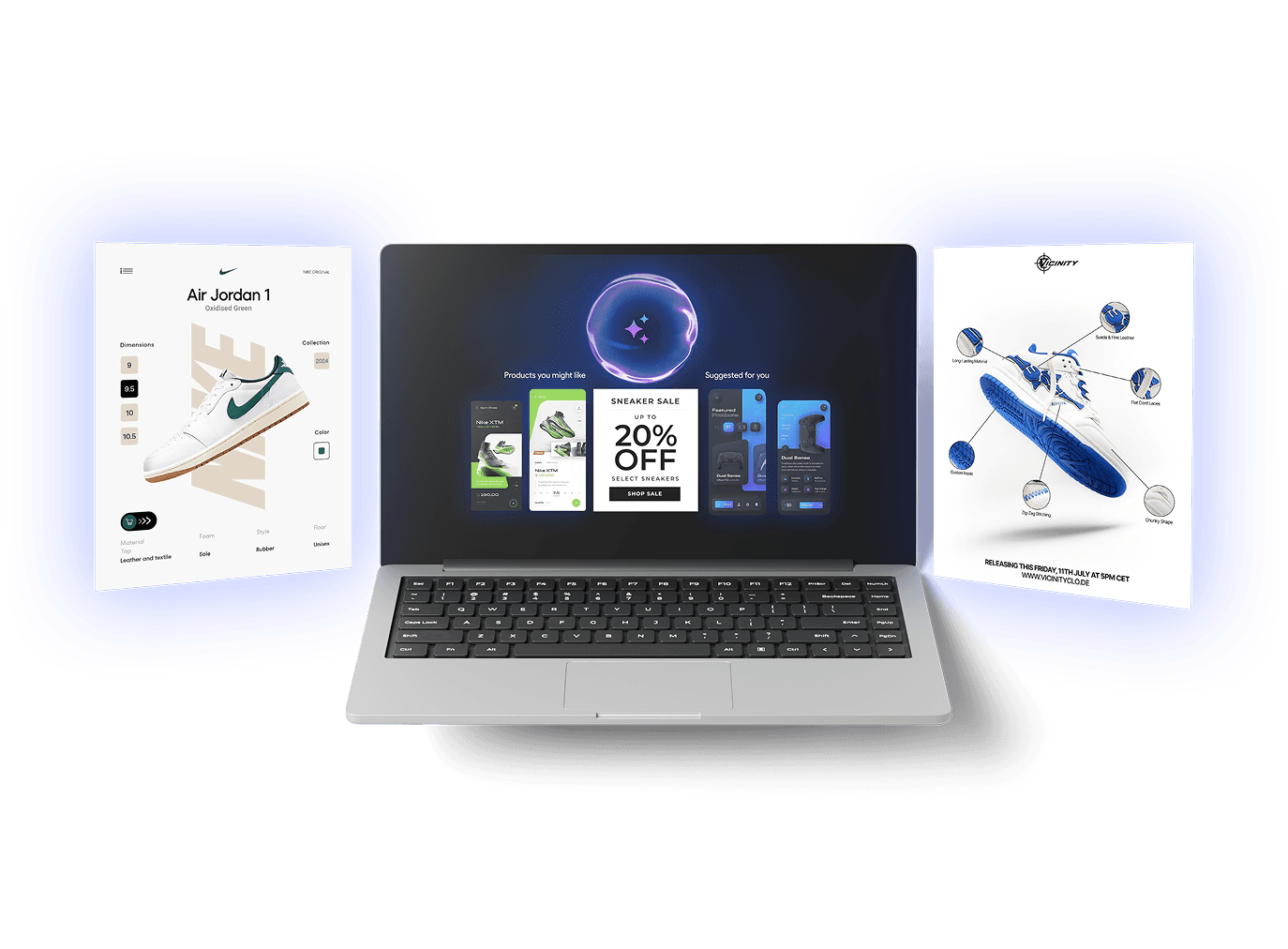
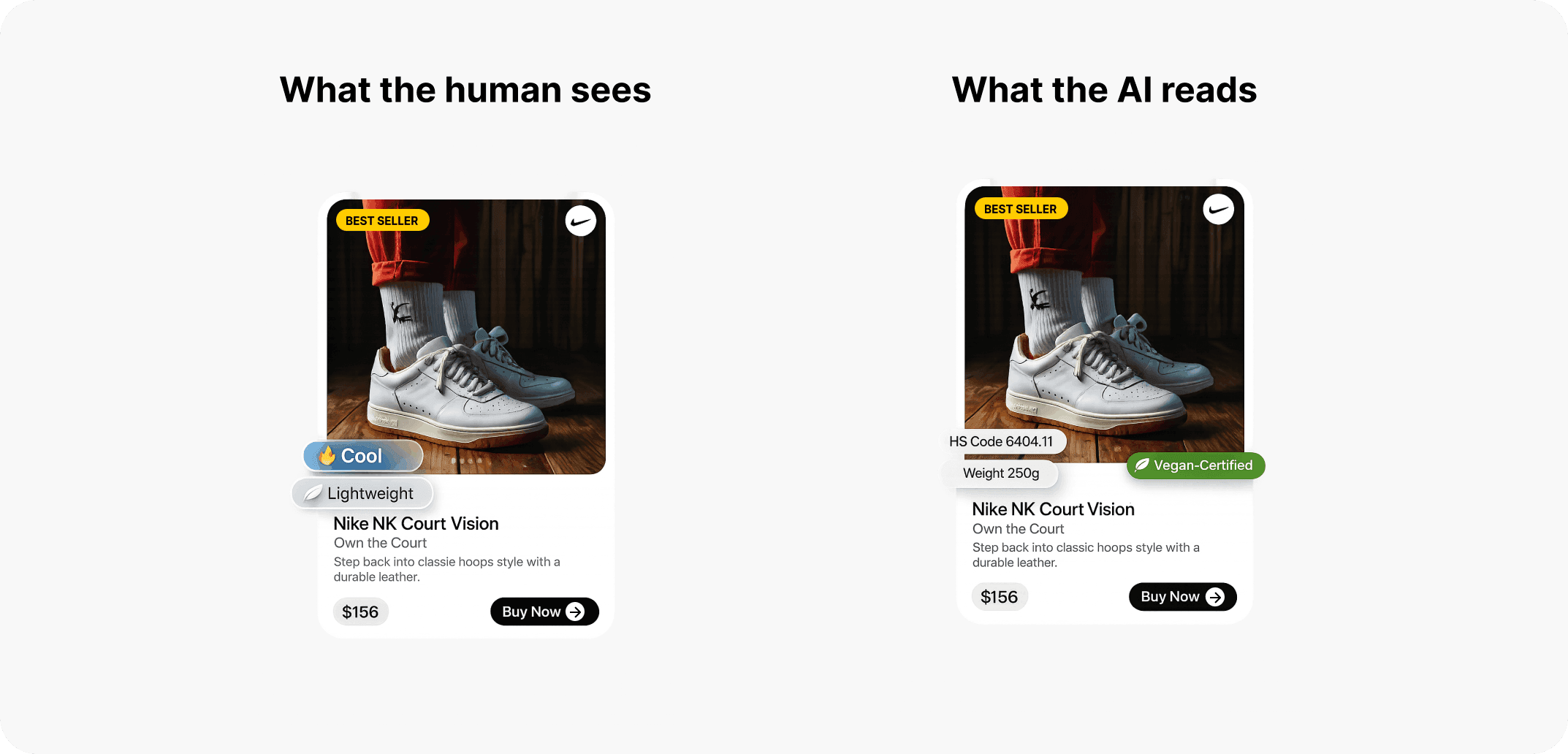
This transition requires a dual-stack marketing strategy that balances emotional resonance with technical precision. While humans still require storytelling and brand resonance to build desire, AI agents require semantic clarity. This means moving beyond prose-heavy descriptions, like calling a sneaker "walking on a cloud," and toward a fact-first structure.
An AI-optimized product description treats every attribute as a data point, specifying precise materials, weights, and certifications in a machine-readable format. This technical DNA must extend beyond basic specifications to include global trade identifiers, such as Harmonized System (HS) codes and tariff classifications. By embedding these necessary codes into the product's data layer, brands enable AI agents to autonomously calculate total landed costs, duties, and international shipping restrictions in real time.
Traditional Google Search
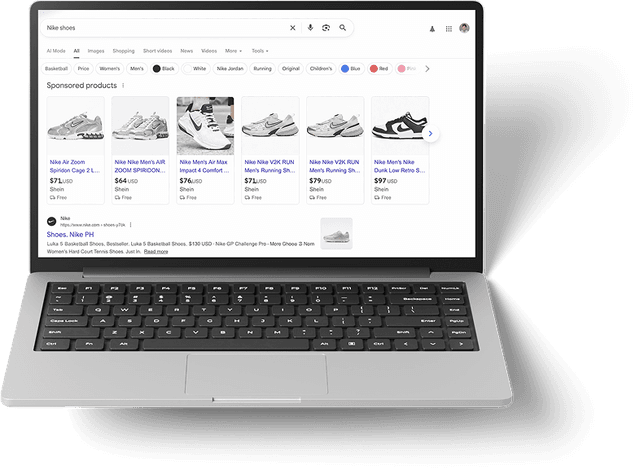
AI Agent Interface
Tip from the Stord Collective: Taxually

Brands that embrace AI will enjoy more personalized marketing, deeper customer insights, and streamlined compliance processes.
AI can help scale operations without expanding headcount and provide the agility needed to adapt to evolving tax regulations.
VAT software can save 50-80% in time and costs for compliance. Testimonials from Taxually clients note that using the platform reduced VAT compliance staff from ten to three, a 70% reduction in full-time equivalents, and saved 20-30 hours per month in VAT preparation. Machine-learning algorithms in Taxually correct tax errors, process data 20× faster, and handle 40,000 tax calculations per minute. However, investing in data quality, privacy and ethics is crucial to maintain consumer trust.
As tax authorities use AI for audits, businesses need robust reporting and should leverage AI tools for internal audits to stay ahead. Digital reporting mandates like the EU's VAT in the Digital Age (ViDA) initiative require real-time data and automation, making AI investment essential for cross-border compliance.
This allows brands to scale into global markets with confidence, removing the need for consumers or merchants to manually navigate the finer complexities of international trade and tariffs. By providing this level of structured certainty, a brand ensures that when a personal assistant is tasked with finding a "vegan running shoe under 9 oz available for delivery today," the agent can confidently select and compare that brand against thousands of competitors in milliseconds.
While the shift toward AEO is inevitable, it is far from perfect. Now is a period of agentic growth hacking that closely mirrors the wide use of black hat SEO in early 2010s, which involved unethical strategies such as keyword stuffing, egregious backlinking, article spinning, and comment spamming. Just as early webmasters manipulated search algorithms, some brands are attempting to trick AI agents through manipulative tactics designed to force a recommendation regardless of product merit.
However, e-commerce leaders should view this as a transient phase. Much like the search engines before them, AEO tools are becoming increasingly intelligent, moving toward sophisticated verification models that penalize manipulation. As these engines grow more competitive and discerning, the hacks of today will be replaced by a rule for deep data integrity. To build a lasting advantage, brands must look past today's shortcuts and focus on providing the structured, high-fidelity data that AI agents will eventually require to maintain their own utility to the consumer.
The rise of AEO and agentic commerce is also forcing a response to the potential decline in traditional ad revenue and efficiency. As AI agents increasingly provide Zero-Click answers, the traditional Pay-Per-Click (PPC) model is losing its utility. If a consumer doesn't click, the ad engine doesn't monetize, and the brand loses the opportunity for top-of-funnel tracking.
To manage this change, brands must pivot from buying traffic to buying influence within the AI model itself. This requires a move toward AI-affiliate models and sponsored inclusion, ensuring the brand is the recommended option in an agent's curated shortlist.
To combat the loss of site traffic, brands are shifting budgets toward owned data ecosystems, incentivizing consumers to connect their personal AI agents directly to the brand's API. This ensures a high-conversion, "always-on" connection with the customer's digital proxy even as traditional search traffic fades.
Beyond discovery, the digital evolution of marketing continues through the deployment of 24/7 digital avatars. These multilingual, brand-accurate personas build emotional trust at a scale that human teams cannot physically match, acting as the brand's personality within the AI interface.
These agents are far more sophisticated than the "frequently bought together" widgets of the past. They utilize anticipatory upsells to analyze real-time intent signals, such as mouse hover patterns or cart hesitation. By sensing the exact moment a shopper pauses or deliberates, these AI agents can offer custom, real-time bundles or incentives, effectively closing the gap between interest and ownership by providing the specific nudge a consumer needs in that exact context.
However, as these digital personas and upselling logics become more pervasive, they must pass a rising authenticity threshold set by the consumer. These interactions must be grounded in verified and real-time databases to prevent the spread of misinformation. This is a critical requirement for maintaining relevance with older and more traditional shoppers who value familiarity and factual consistency. By ensuring that every AI-driven suggestion is cross-referenced against actual inventory and brand specifications, brands can provide the utility that younger shoppers demand without alienating the legacy segments who cite a lack of trust as their primary reason for avoiding these tools.
Product Evolution with AI-Driven Design
The traditional year-long product development cycle has been shortened into weeks through AI-driven design. Brands now offer co-creation tools that sync with a user's digital wardrobe to suggest custom modifications or new items that complement existing styles.
To minimize risk, brands utilize ghost SKUs and synthetic customer personas where AI models trained on millions of data points can act as invisible focus groups, predicting performance before a single unit is manufactured. This agility allows for micro-drops that respond to social media virality in real-time, provided the brand is supported by a reliable fulfillment partner that can handle the extreme logistics of small-batch, rapid-deployment fulfillment.
This shift toward AI-augmented design also serves as a response to the growing consumer desire for personalized agency. While younger cohorts are comfortable with AI-led curation, many still fear a loss of personal authorship in their shopping. By offering co-creation tools, brands allow the consumer to remain the final decision-maker. This approach turns a potential point of friction, such as the fear of a machine-made lifestyle, into a personalized experience that respects the user's creative control.
Prescriptive Demand Planning
The most efficient brands have transitioned from reactive sales reports to a sense-and-respond infrastructure. By deploying AI agents that ingest external signals, such as weather shifts and geopolitical social sentiment, e-commerce operators can predict demand with near-perfect accuracy. When a trend is sensed, the system autonomously triggers replenishment, moving stock through a distributed warehouse network to the specific node closest to the predicted demand spike.
However, this predictive capability is only actionable if the underlying fulfillment logic is flexible enough to keep pace. As brands grow, they often implement hundreds of individual rules to manage every case in the fulfillment process, ranging from determining the specific shipping label to selecting the correct branded insert for a particular customer segment. Historically, these rule sets have been difficult to build and even harder to manage because multiple rules can inadvertently conflict with one another and result in unexpected shipping behaviors.
This creates a significant amount of decision fatigue for human operators who must manually diagnose and fix logic errors as they arise. AI is now being utilized to navigate this complexity by autonomously assessing, diagnosing, and building these workflows.
Tip from the Stord Collective: Parabola

AI is going to let brands scale without scaling headcount the same way, ultimately improving margins. A brand that used to need a massive team to run manual operations can now run leaner because each person has way more leverage through AI tools and automation. That means brands can grow faster and operate more consistently, without needing to add layers of people just to keep up with volume.
The best brands will use AI to build better systems early, so they can scale cleanly without sacrificing customer experience.
The other thing we see very clearly is employee happiness and retention go way up, as operators no longer have to do all of the manual drudgery that was previously such a big part of their role.
Stord enables brands to cut through confusion by identifying conflicting logic and applying a resolution in real time. By using natural language to build exception logic, brands can maintain sophisticated fulfillment strategies without the overhead of manual rule management. This ensures that the physical movement of goods is as precise as the predictive data that triggered the order.
For the skeptical shopper, the most effective way for a brand to prove its AI's value is through reliability. When a micro-trend hits and the product is already staged at the nearest node for same-day delivery, the brand validates the AI's utility through physical performance. This performance-based trust is often more effective than any marketing campaign at converting the wary consumer who remains hesitant about AI's role in their daily life.
Tip from the Stord Collective: Moselle

AI is collapsing the planning advantage gap between enterprises and emerging brands. Sophisticated forecasting used to require dedicated ops teams, expensive consultants, or enterprise software with long implementation cycles. But that's changing.
Moselle is supporting brands that are serious about enabling AI for inventory planning, championing the "do more with less" mindset. This shifts the competitive advantage from "who can afford the best planning infrastructure" to "who can act on better insights faster."
Brands that embrace AI for planning free up their teams to focus on growth, product, and customer relationships. With Moselle, DTC brands can now run scenario analysis in natural language, asking questions like "If I only have $100,000 to spend on inventory, what should I cut from this order?" and getting actionable answers in minutes.
But it's not just about planning in isolation. AI tooling creates visibility across the entire business to keep sales, operations, and marketing aligned around the same demand signals enabling the whole business to move faster and smarter together.
The AI Infrastructure of Integrity
While these functions define the brand promise, they are only as effective as the physical infrastructure behind them. A marketing agent can promise "Next-Day Delivery" and a service agent can offer an "Instant Exchange," but these commitments carry no weight if the fulfillment systems and infrastructure are fragmented. In AI-driven commerce, the front-end promise of a proactive customer experience creates massive complexity for the backend.
AI and the Future of Autonomous E-Commerce Execution
The brand represents the intent. The operator represents the execution.
Whether managed in-house or through a specialized partner, the operator serves as the functional and reality layer of e-commerce. A brand cultivates the customer relationship, and the operator ensures precision of fulfillment, logistics, and inventory. In this ecosystem, AI acts as either the internal tool for managing complexity or the coupling mechanism that ensures operations move in lockstep with marketing intent.
AI Adoption Among E-Commerce Operators
While brands show aggressive adoption on the front-end, the backend remains hindered by fragmented legacy systems. While 74% of supply chain practitioners identify AI as their primary driver through 2026, only 29% of organizations currently possess the infrastructure to execute it.8
To push adoption forward, operators must first resolve legacy problems, mainly due to data debt, by moving away from batch processing, where updates occur every 4+ hours, toward real-time data streaming. This transition is critical to eliminating the synchronization lag that causes overselling during viral drops, ensuring that AI agents are making decisions based on real-time data rather than historical snapshots.
The transformation toward autonomous execution also requires a reallocation of resources. Currently, "keeping the lights on" for legacy systems consumes up to 31% of IT budgets.40 By modernizing the stack and unifying fragmented WMS, ERP, and storefront ecosystems into a single source of truth, operators can redirect these funds toward agentic execution, which is the layer that actually drives revenue and customer loyalty.
How Can Operators Use AI to Uplevel the Consumer Experience?
E-commerce operators must move from using AI as a reporting tool to an automated decision-maker. Currently, most AI in the warehouse and logistics space is used reactively: to analyze what went wrong after a delay occurs, to explain why a cost spiked, or to provide visibility into historical stock levels.
The opportunity lies in moving AI from the sidelines of analytics into the center of real-time execution. By shifting from descriptive data (what happened?) to prescriptive action (what should we do right now?), operators can solve the complexity that breaks the customer journey. This evolution requires embedding AI across the following critical backend functions to turn the front-end brand promise into a certainty.
Prescriptive Inventory Management
The most efficient operators have moved beyond legacy forecasting by deploying AI agents that ingest an expansive array of external signals. Rather than relying solely on internal sales history, these systems now process a high-dimensional spectrum of data, ranging from shifting weather patterns and geopolitical risks to the nuances of real-time social sentiment. By synthesizing these varied inputs with global economic indicators and localized supply chain disruptions, AI creates a high-definition view of the market.
TIP FROM THE STORD COLLECTIVE: MOSELLE

AI doesn't replace operators, it changes what they spend their time on.
Instead of spending hours in spreadsheets, pulling and cleaning data and manually adjusting forecasts, they'll learn to collaborate with AI using their expertise, intuition and market knowledge to guide them.
With Mo, Moselle's AI inventory planner, operators can query their demand plan, gain insights, and take action all in natural language.
This kind of speed unlocks something bigger: operators shift from reactive number-crunching to proactive, strategic decision-making. The operators who thrive will be the ones who learn to work alongside AI using it to amplify their judgment, not replace it. They'll become trusted partners to leadership, gaining real-time insights to take action with data they can actually stand behind.
Tasks that used to take 30 minutes of manual work now happen in a couple of prompts and teams are reclaiming 10-15 hours a week on business operations.
This intelligence allows the warehouse and transportation networks to adapt to emerging trends long before they manifest as traditional order volume. When the system identifies an emerging trend, it autonomously triggers replenishment and moves stock through a distributed warehouse network to the specific node closest to the predicted demand.
By positioning resources with surgical precision, operators can ensure that the physical fulfillment network is prepared for the resulting demand spike without the risk of overstocking secondary locations, fostering a leaner inventory model that maintains high service levels without the traditional carrying costs.
Automated Tax Compliance
Operators play a critical role in translating complexity into simplicity for the brands they serve. One area where this impact is particularly pronounced is tax compliance, an often invisible but consequential component of the consumer experience.
Errors, delays, or inconsistencies in tax calculation and reporting can create downstream friction, from pricing inaccuracies at checkout to fulfillment delays and post-purchase disputes. AI offers operators a powerful mechanism to address these challenges at scale.
TIP FROM THE STORD COLLECTIVE: TAXUALLY

For tax and finance operators, AI-driven platforms such as Taxually can reduce manual workloads and enable teams to deliver more value with fewer resources.
Leveraging AI for internal audits also helps businesses stay ahead of regulatory checks. As AI handles data collection, calculation and filing, operators remain responsible for ensuring data quality, interpreting AI outputs, and managing exceptions.
Taxually's clients report reductions of up to 70% in full-time equivalents, alongside monthly time savings of 20-30 hours.
These efficiencies enable tax professionals to redirect effort toward higher-value activities, including strategic planning, risk management, and advising on complex cross-border issues, which are critical to long-term success in e-commerce.
By embedding compliance intelligence directly into commerce and fulfillment workflows, operators can help ensure that pricing, duties, and taxes are applied accurately and consistently, reinforcing trust at the point of purchase.
Intelligent Logistics and Smart Routing
The last mile of delivery is a volatile part of the customer journey. Its complexity is defined by the requirement to coordinate thousands of unique, low-density drop-off points, each with its own set of variables such as restricted delivery windows, varying gate access requirements, and hyper-local traffic congestion. These factors, combined with fluctuating fuel surcharges and the high labor costs of doorstep service, create an environment where small delays at a single stop can cascade into systemic inefficiencies.
The last mile often accounts for more than 53% of the total shipping expenditure,11 which means even minor disruptions can lead to massive cost fluctuations that reduce profit margins. To mitigate these risks, operators are moving away from static carrier contracts in favor of AI-driven management. AI-powered solutions like Stord Parcel utilize machine learning to analyze real-time carrier performance, capacity, and rate changes across thousands of lanes simultaneously. By dynamically selecting the optimal carrier and route for every individual parcel, it ensures that the final leg of the journey remains both cost-effective and reliable.
Beyond simple management, AI now performs active intervention to maintain the integrity of the fulfillment network. If a regional backlog or carrier disruption is detected, the network can autonomously trigger pre-emptive replacement shipments or reroute stock before the delay impacts the end consumer. These self-correcting networks have been reported to improve service levels by 65% while simultaneously reducing logistics costs by 15%.10
Furthermore, the integration of AI-powered Estimated Delivery Dates (EDD) has transformed the final mile from a source of anxiety into a primary driver of customer retention and conversion. By processing historical shipment data alongside real-time warehouse conditions, operators can provide a transparent delivery promise that accounts for potential delays before they occur. This level of precision reduces the volume of customer inquiries and fosters a sense of reliability that physical performance alone cannot achieve. Managing the last mile effectively is not just about moving a box but about utilizing data to stabilize the costs and expectations of the most expensive part of the fulfillment process.
Fulfillment and Collapsing the Click-to-Ship Window
The time between when a customer clicks buy and when the product is shipped is where customer anxiety lives. To collapse this window, operators are treating the physical warehouse as a software-defined space that responds to digital signals in real time. This agility is achieved by synchronizing every movement on the floor with live global demand, ensuring that physical output can match the speed of viral social trends.
By shifting from rigid, batch-based processing to a model of elastic execution, warehouses can now scale their operations digitally. This intelligence guides everything from the physical layout of the building to the specific path a worker takes, using AI to eliminate the structural delays that define legacy fulfillment.
TIP FROM THE STORD COLLECTIVE: PARABOLA

Operators have historically been stuck doing monotonous spreadsheet work: exporting data, cleaning it up, reconciling issues, and pushing updates across systems.
It's repetitive work that keeps great operators from spending time on higher-impact problems.
With AI, even non-technical operators can automate a lot of that repetitive work without relying on engineering. That frees them up to own more of the business, take on more complex challenges, and ultimately make a bigger impact and grow their careers faster.
Furthermore, by integrating visual pick-to-light systems, operators ensure that this increased velocity does not compromise order integrity. This transition allows brands to maintain a high accuracy rate even during high-velocity micro-drops, virtually eliminating the mis-picks that lead to costly returns and damaged consumer trust.
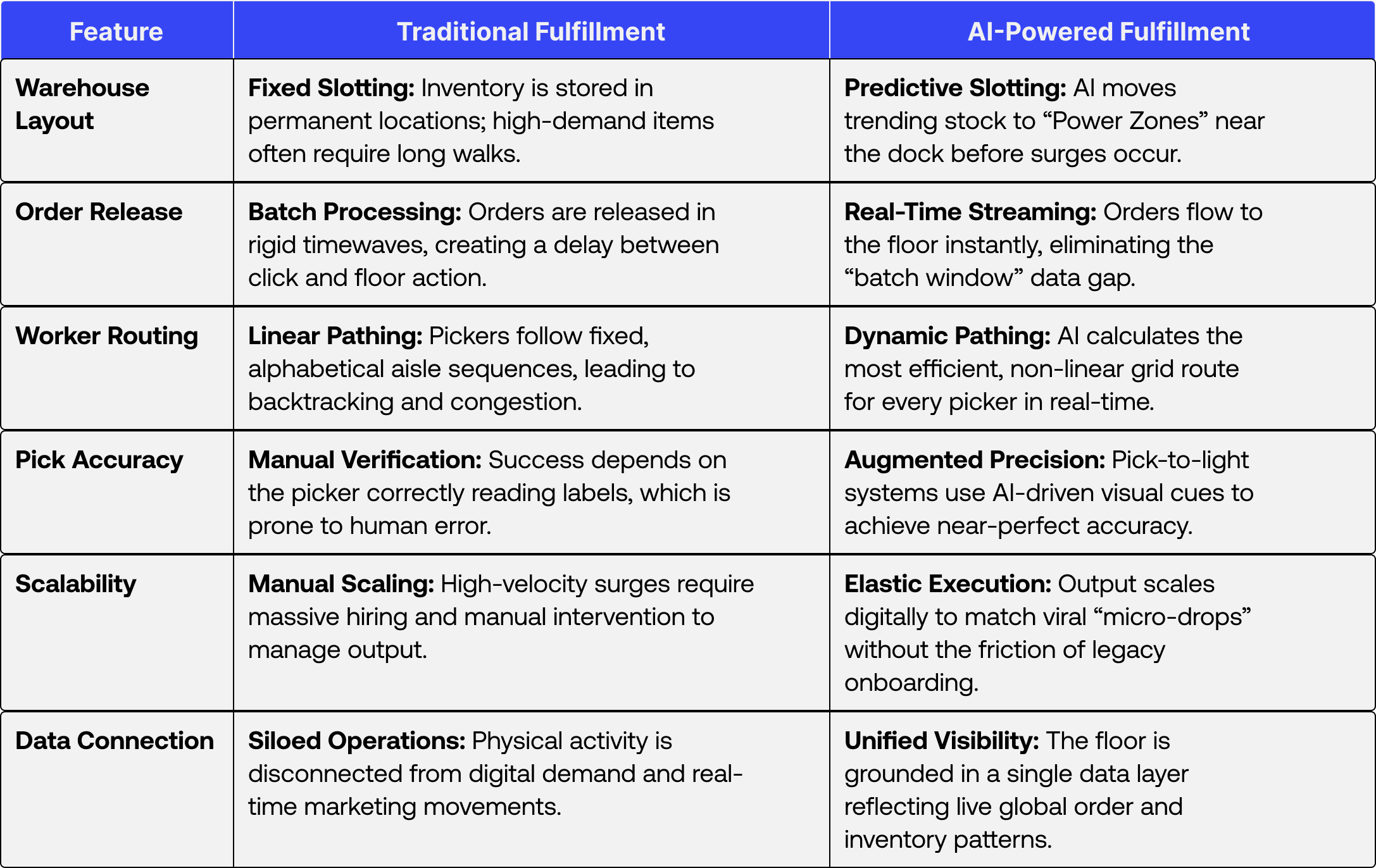
Handling these high-velocity events requires a fulfillment partner that can bypass the friction of legacy 3PL systems, which organizations cite as a major blocker to AI effectiveness.
Autonomous Resolution and Reverse Logistics
The intelligence driving fulfillment forward must also be applied when products need to journey back to a warehouse or fulfillment center, such as when a customer initiates a return. Rather than relying on human-managed support tickets, brands are now deploying agentic service agents to handle "Where Is My Order" (WISMO) inquiries and return requests. More than providing status updates, these agents possess the authority to see, respond to, and resolve issues in real-time.
By analyzing customer lifetime value and item condition at the moment of contact, the system autonomously decides whether to offer an instant exchange, a returnless refund, or a specialized loyalty incentive. If a return is initiated, the agent matches the reason for the return with live inventory data to offer an alternative product before the customer leaves the digital storefront. This automation removes the friction of manual human review and allows operators to maintain the 30% increase in CLV seen by brands with AI integration.5
Computer vision grading changes the economics of this process by enabling returned items to be restocked in minutes rather than weeks. When a product is received, integrated cameras instantly assess its condition to determine if it should be routed back to prime inventory, sent to a secondary marketplace, or recycled. This transformation converts returns into a high-velocity inventory opportunity by ensuring that returned goods are reintegrated into the sales channel with minimal delay.
Protecting Brand Reputation
When e-commerce operators optimize the backend functions with the help of AI, they do more than just move boxes. They add a layer of protection to the brand's reputation. By implementing an infrastructure capable of automated decision-making, operators provide the physical reality that turns a one-time shopper into a lifelong advocate. However, the road to autonomous execution is rarely linear, and the transition from legacy systems to agentic intelligence has provided a wealth of practical data on what works and what doesn't.

What We've Learned From AI Use So Far
The early adopters of AI have provided e-commerce brands and operators with a roadmap for building systems that are grounded in reality rather than hype. To improve the strategy for 2026, e-commerce leaders must look at the early iterations of AI not as failures, but as the necessary lessons that have shaped best practices and use cases.
Authenticity Over Automation
In the early wave of adoption, many brands assumed consumers prioritized the fastest possible response above all else. However, the industry learned that speed without accuracy damages loyalty. A landmark 2024 case involved an Air Canada chatbot that hallucinated a bereavement policy, leading to a legal ruling that the airline was liable for its AI misinformation.41
This is a case that highlighted the legal and reputational risks of lying AI. This served as a reminder that consumers do not view AI as a separate entity. They view it as the voice of the brand.
Consequently, the 2026 pivot for brands has been the utilization of Retrieval-Augmented Generation (RAG) to ensure AI agents are grounded in a verified database before they speak.42
This ensures every interaction is factually accurate and brand-aligned.
Personalized, Dynamic Pricing
One of the most sensitive lessons involved using AI to adjust pricing based on individual user data, such as device type, browsing history, location, or previous travel history.
Delta Airlines drew significant fire from U.S. lawmakers when it announced plans to use AI for ticket pricing, sparking a heated debate over "surveillance pricing" (the practice of using AI to charge different prices to different people for the same product based on their personal data and perceived "urgency" to buy) and the potential for algorithmic price discrimination.43
In late 2024, the Federal Trade Commission (FTC) issued orders to eight major firms to investigate the opaque industry of surveillance pricing.44
The core learning here is that just because an AI system can predict the maximum amount a user is willing to pay, it does not give brands liberty to levy these additional charges. To maintain trust in 2026, brands should move to Value-Based Dynamic Pricing, where AI adjusts prices based on transparent factors, like real-time inventory levels or shipping distances, rather than individual consumer profiles.
Augmented Intelligence and Scaling with Guardrails
While the potential for autonomous execution is vast, the industry has learned that unmonitored AI can lead to catastrophic blind spots.
A notable example occurred during Zillow's iBuying journey, which resulted in an estimated $500 million loss and the eventual shuttering of their home-buying division.45 The failure was driven by an algorithm that could not account for the nuance of a shifting housing market.
The AI continued to purchase homes at inflated prices based on historical "pandemic-boom" data, ignoring the real-time cooling of demand that a human strategist would have easily detected. This over-reliance on a static model in a volatile environment forced the company to sell thousands of homes at a loss.
To avoid this pitfall, brands should utilize augmented intelligence, where AI handles the volume but humans provide the contextual guardrails.
For example, Klarna's AI assistant successfully manages the volume of two-thirds of customer service chats, doing the work of 700 full-time agents, while maintaining high customer satisfaction by escalating complex disputes to humans.46
Similarly, Stitch Fix utilizes an Experts-in-the-Loop model where algorithms process millions of data points to suggest styles, but a human stylist makes the final selection.47 This ensures the speed of AI is always guided by human integrity.
Amplifying Errors of Disconnected Visibility
For operators, the most consequential lesson is that AI can act as an amplifier. When foundational data and processes are misaligned, AI cannot mask these weaknesses; it accelerates their impact, causing failure to propagate faster and at greater scale.
Target famously faced a massive inventory glut in 2022 when its predictive models, fueled by skewed pandemic-era demand signals and disconnected from real-world shifts, led to over-ordering.48 This resulted in rapid profit loss as they were forced to aggressively mark down stock.
Similarly, despite a massive investment in an AI-driven direct-to-consumer strategy, Nike struggled with inventory gluts and declining sales because their digital systems were siloed from the physical reality of their wholesale channels.49 This fragmentation prevented their AI from seeing a unified picture of global demand.
These cases underscore a fundamental constraint of AI in e-commerce: intelligence cannot compensate for disparate e-commerce and fulfillment systems. The prerequisite for realizing AI's full potential is a foundation of clean, integrated data that reflects the end-to-end digital and physical reality of the commerce stack and logistics network in real time.
The Future is AI-Commerce
AI will continue to evolve in ways that extend well beyond today's use cases.
As with prior technological inflection points, the most consequential applications of AI may emerge from entirely new ways of interacting with commerce ecosystems that unlock capabilities that are difficult to fully anticipate. What is clear is that AI's trajectory is not linear. Its pace of innovation and diffusion suggests a future in which intelligence is embedded deeply and persistently across the end-to-end commerce lifecycle.
Just as the shift from physical retail to e-commerce redefined how consumers discover, evaluate, and purchase products, the current evolution of AI is introducing a new paradigm of retail: AI-commerce.

AI-commerce is characterized by highly adaptive interfaces, autonomous agents, continuous hyper-personalization, and decision systems that operate in real time across channels. AI-commerce will not simply optimize existing e-commerce models, but will continue to reshape, restructure, and revolutionize e-commerce as we know it.
Regardless of where this AI-powered trajectory ultimately leads, one conclusion is increasingly unavoidable: AI will continue to transform how consumers experience and interact with brands. As consumers adopt AI across the end-to-end online shopping journey, brands must be equally prepared to integrate AI across their own value chains. This integration extends beyond front-end experiences into the engines and systems that power customer experiences behind the scenes. Achieving this level of coordination will require reliable fulfillment and logistics partners that are also investing in AI capabilities with a clear path forward on where and how it will deliver the most value.
Artificial Intelligence is everything, everywhere, all at once. It is becoming pervasive across industries. And rather than dissipating, AI is only becoming increasingly embedded in retail ecosystems because its economic, operational, and experiential opportunities are too significant to ignore. The investments and implementations initiated in 2025 are expected to accelerate and compound in 2026, as organizations move from experimentation to rapid execution. Businesses that fail to adapt will find it increasingly hard to compete.