









Most e-commerce brands will never meet their customers. Unlike traditional retail, the relationship lives almost entirely through screen—where people discover products through ads and social media, explore through influencers, browse websites, read marketing emails, and then check out without ever speaking to someone from sales.
The first physical connection from the brand arrives days later as a package.
Yes, unboxing is the only marketing channel with a 100% open rate. Every customer opens the package, which makes it one of the most valuable – yet underutilized – moments in the entire commerce relationship. 77% of consumers say they think more favorably of brands that invest in well-designed packaging,1 yet only 36% of e-commerce brands include any insert or sample to enhance that moment at all.²
Most brands still treat the unboxing experience as a logistics output rather than a brand experience, not because they think that’s enough, but because their systems have never let them do more. The way modern e-commerce works, everything is built around relevance. Brands segment customers, personalize offers, and use behavioral data to make every online interaction more meaningful.
Personalization is no longer a differentiator so much as the cost of competing, and the brands that get it right are the ones that keep customers coming back. In fact, personalized subject lines are 26% more likely to be opened, and personalized CTAs generate a 202% lift in conversions.³ A first-time customer sees a different experience than a repeat purchaser, a lapsed customer gets a different message than a VIP, and that’s become the baseline expectation across every digital touchpoint.
But once the order ships, all of that customer intelligence stops being applied. A high-value customer gets the same experience as someone who bought once during a promotion. No marketer would intentionally build an email or SMS program this way, yet it’s surprisingly common inside fulfillment.
What happens when customers open the box
The importance of the unboxing moment is frequently underestimated because it is viewed more as presentation rather than performance. Customers do not see it that way. They notice whether the package feels intentional, whether the presentation reflects the way they perceive the brand, and whether the experience inside the box is consistent with what was promised online.
73% of Gen Z say a poorly packed order has lowered their opinion of a brand, higher than any other generation, and 53% rank packaging presentation among the most important factors in that moment.4 56% of consumers say premium packaging makes them more likely to buy again.5 For younger consumers in particular, packaging is not separate from the product experience.
The insert is where the most direct commercial conversation happens. The single factor most likely to drive a repeat purchase from an unboxing experience is a coupon, discount, or credit toward a future purchase as cited by 47% of consumers, followed by free samples at 24%.6 That insert is the brand’s handoff from the product to the next transaction. When it reflects who the customer is and what they actually bought, it outperforms a generic card by a significant margin. Most brands already know this. But the challenge has always been execution, not intent.
The one-size-fits-all dilemma
Compare how brands market online to how they communicate inside the box, and the gap is stark. By the time an order reaches the fulfillment center, the segmentation brands built across email, SMS, and advertising disappears. Unboxing defaults to one-size-fits-all, even though no customer is.
Below are some of the most common lifecycle stages of customers, and how brands either miss or win them the moment the order ships.
Customer Type | What Some Brands Do | What a Relevant Experience Looks Like |
|---|---|---|
First-time buyer | Generic thank-you insert | Welcome message, product education, or recommendations that help them get more value from their first purchase |
Repeat customer (3–5 orders) | Same generic insert | Loyalty acknowledgment and recommendations based on previous purchases |
High-AOV / VIP customer | Same generic insert | Exclusive access, special offers, or messaging that recognizes their status |
Gift purchaser | Same generic insert or gift notes printed on the receipt | Branded, designed card with a custom message added by the buyer |
Subscription customer | Same generic insert | Usage tips, replenishment reminders, or complementary product recommendations |
For years, physical marketing materials were static by necessity. Brands designed inserts, printed them in bulk, and distributed them broadly because that was the only practical option financially and operationally. Running six different inserts for six different audiences meant six print runs and a complicated pack-out process that most teams cannot execute. The economics pushed every brand toward generalization.
Making hyper-personalization beyond checkout possible
Stord Unbox removes that cost. Brands can apply the same customer intelligence they already use in digital marketing directly to the fulfillment workflow, with inserts printed on demand at pack-out. It connects to the systems brands already run on, Shopify, Klaviyo, and existing customer data, then triggers inserts by behavior, lifecycle stage, or order value and auto-matches the right one to each order.
Because printing happens on demand at pack-out, a welcome message for first-time buyers and a re-engagement offer for lapsed customers can run at the same time, with entirely different creative, from the same facility, and with no disruption to warehouse operations.
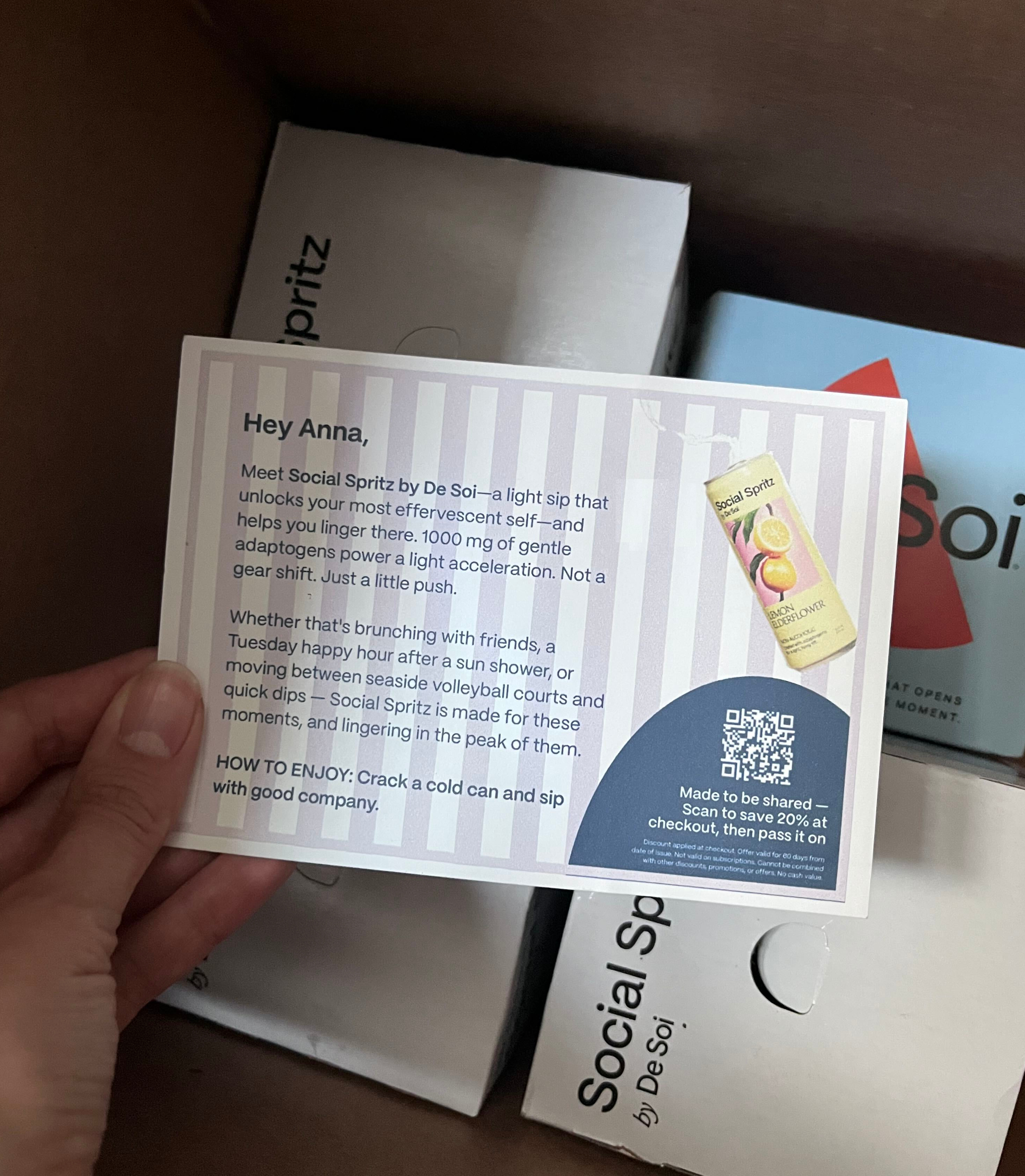
The same approach extends to cross-sells, subscription upsells, replenishment reminders, and gift messaging, each triggered by who the customer is and what they actually bought. And because every insert can carry a QR code, promo code, or unique URL, the box becomes as measurable as any digital campaign.
It’s one example of a broader shift in how brands think about fulfillment. Instead of treating it as the point where customer engagement ends, leading brands are treating it as part of the customer experience, and the early results suggest the approach is paying off. Brands running personalized insert programs have seen up to a 25% lift in average order value, an 11% increase in repeat purchases, conversion as much as 4x higher than a post-purchase email, and 6 to 10 times the return of traditional channels.7 Those figures reflect historical performance and vary by industry, pricing, and other factors, but the direction is consistent.
The box, once treated as the end of the transaction, is becoming one of the most measurable channels a brand owns.
Checkout has never been the finish line
Winning the first order is expensive. Winning the second, third, and fourth order is what creates long-term customer value, and the post-purchase experience plays a larger role in that outcome than many brands realize.
A generic unboxing experience probably won’t cost a sale. But it can miss the chance to reinforce the brand, deepen the relationship, introduce another product, or give a customer a reason to come back. The brands making the most progress on retention aren’t the ones spending the most on acquisition. They’re the ones paying attention to every part of the customer experience.
Brands have spent years optimizing every digital touchpoint. The box is still one of the only moments a customer engages with a brand free of competing messages, algorithms, or distractions.
The box has always been there. Now the smart brands are putting it to work.


