










E-commerce is drowning in data. That’s not the problem. The problem is that turning that data into actionable decisions still takes too long.
Global e-commerce sales are expected to exceed $6.86 trillion in just 2 years,1 with more than 2.8 billion people shopping online worldwide.2 As the industry grows, so does the volume of data generated across every customer interaction, inventory, order, shipment, and return.
For many brands, this means managing millions of data points across marketing, sales, fulfillment, and logistics. Properly analyzed, this data can reveal customer behavior trends, identify operational inefficiencies, support demand forecasting, help optimize fulfillment strategies, and more. These insights ultimately power the decisions that allow brands to improve performance and deliver better customer experiences.
However, transforming raw data into actionable insight is a process that is slow by design. Data moves through analysts, into reports, up to leadership, then back down as decisions. Every handoff adds hours.
As analysts pull data from their WMS, check carrier feeds, cross-reference routing rules, and surface a root cause, hours have already passed. In an industry where customer expectations continue to accelerate, these delays can translate directly into lost revenue, dissatisfied customers, and missed opportunities to resolve issues in real time before they compound.
The Data-to-Action Problem
Technology has steadily evolved to close the gap between data and action.
In the early days, producing a single report often took between 4-10 hours of manual work.3 Analytics platforms cut that by more than 50%.4
At the same time, however, the very technologies that streamlined analytics also helped accelerate the growth of digital commerce itself. As e-commerce platforms, marketing tools, and fulfillment systems became more sophisticated and widely adopted, the scale and speed of online commerce expanded rapidly. With that expansion came a new challenge: a dramatic increase in both the volume and complexity of the data being generated.
Today’s e-commerce brands operate across dozens of interconnected systems: storefronts, marketing platforms, warehouse management systems, transportation networks, customer experience tools, and more. At a global level, the amount of data generated each day is growing at an extraordinary pace, increasing by roughly 22% year over year.5 Each platform produces continuous streams of data that must be collected, reconciled, processed, and interpreted before they can inform business decisions. As a result, even well-equipped commerce teams still often require hours or days to move from raw data to actionable insight, despite modern analytics infrastructure.
Thus, the challenge has remained the same: how to turn data into decisions as quickly as possible.
AI doesn’t just speed up reporting; it eliminates the lag between data and decision entirely. Rather than simply accelerating reporting workflows, AI is redefining how insights are generated, compressing processes that once took hours or days into minutes (even seconds), and enabling organizations to move from reactive firefighting to proactive intervention.
AI and E-Commerce
Insights from Stord’s State of AI in E-Commerce Report reinforce how AI will not simply optimize existing e-commerce workflows; it will fundamentally reshape how digital commerce operates.
For brands and operators, AI is rapidly moving from a supporting tool to a core operational layer within commerce technology stacks. It can power product recommendations, fraud detection, dynamic pricing, customer support automation, demand forecasting, warehouse optimization, and more. These AI capabilities allow brands to operate faster, more efficiently, and with greater precision than ever before.
But one of the most powerful and intuitive applications of AI has emerged through a simple interface: Chat - the ability to ask a question and receive an answer instantly.
For consumers, this has fundamentally changed the way they shop online. Stord’s recent AI sentiment survey found that 51% of consumers have used AI for online shopping, with 17% using AI conversational tools regularly to help find the products they need. This represents approximately 135 to 140 million e-commerce consumers in the US actively relying on AI in their shopping journeys today.6 Consumers already use AI to find products in seconds. The irony is that the operators fulfilling those orders are still waiting hours for a report to tell them why something went wrong.
Now imagine bringing that same capability into e-commerce operations.
Instead of navigating multiple dashboards or waiting for analysts to generate reports, an operator could simply ask a question and receive an immediate, data-backed answer. A fulfillment manager could ask why shipping delays are increasing, or a warehouse operator could instantly identify which area is experiencing the highest processing latency.
For e-commerce brands managing complex and rapidly dynamic operations, the ability to access insights through simple conversation isn’t just an incremental improvement, it removes the analyst as the bottleneck entirely.
Ask, Answer, Action
We process $10B+ in commerce annually across hundreds of brands. We see this problem every day - at real scale, in real operations. That’s why we built StordAI differently.
What sets Stord apart from the many companies rushing to adopt AI is how these capabilities are built. Rather than layering generic AI tools onto existing systems, each AI-powered capability is designed to solve the most critical operational challenges that e-commerce brands face every day. One of which is the complexity of transforming massive volumes of data into actionable insights quickly enough to drive real-time action.
To solve this problem, Stord introduced a powerful new capability within the StordAI platform: StordAI Chat.

StordAI Chat reimagines how brands interact with their data. Through a conversational interface, operators can quickly access insights across their commerce operations, analyze fulfillment performance, investigate shipping delays, explore inventory trends, and identify operational bottlenecks in seconds. In fact, field studies in enterprise environments show measurable gains in throughput when AI assists. Teams using AI are significantly more productive, completing 12% more tasks on average and finishing them 25% faster.7
This capability is particularly valuable in an environment where operational conditions change rapidly. Sudden spikes in order volume, carrier disruptions, inventory shortages, or fulfillment bottlenecks can emerge with little warning, and the ability to diagnose these issues immediately allows teams to respond faster and prevent small problems from escalating into larger operational disruptions.
With any AI-powered tool, reliability and accuracy are critical. Businesses must trust that the insights they receive reflect the real conditions of their operations.
What makes StordAI Chat different is the data foundation on which it is built. The system is trained on millions of fulfillment and logistics data points generated across Stord’s network: orders, inventory, workflows, routing logic, shipping events, compliance codes, historical performance, and more.
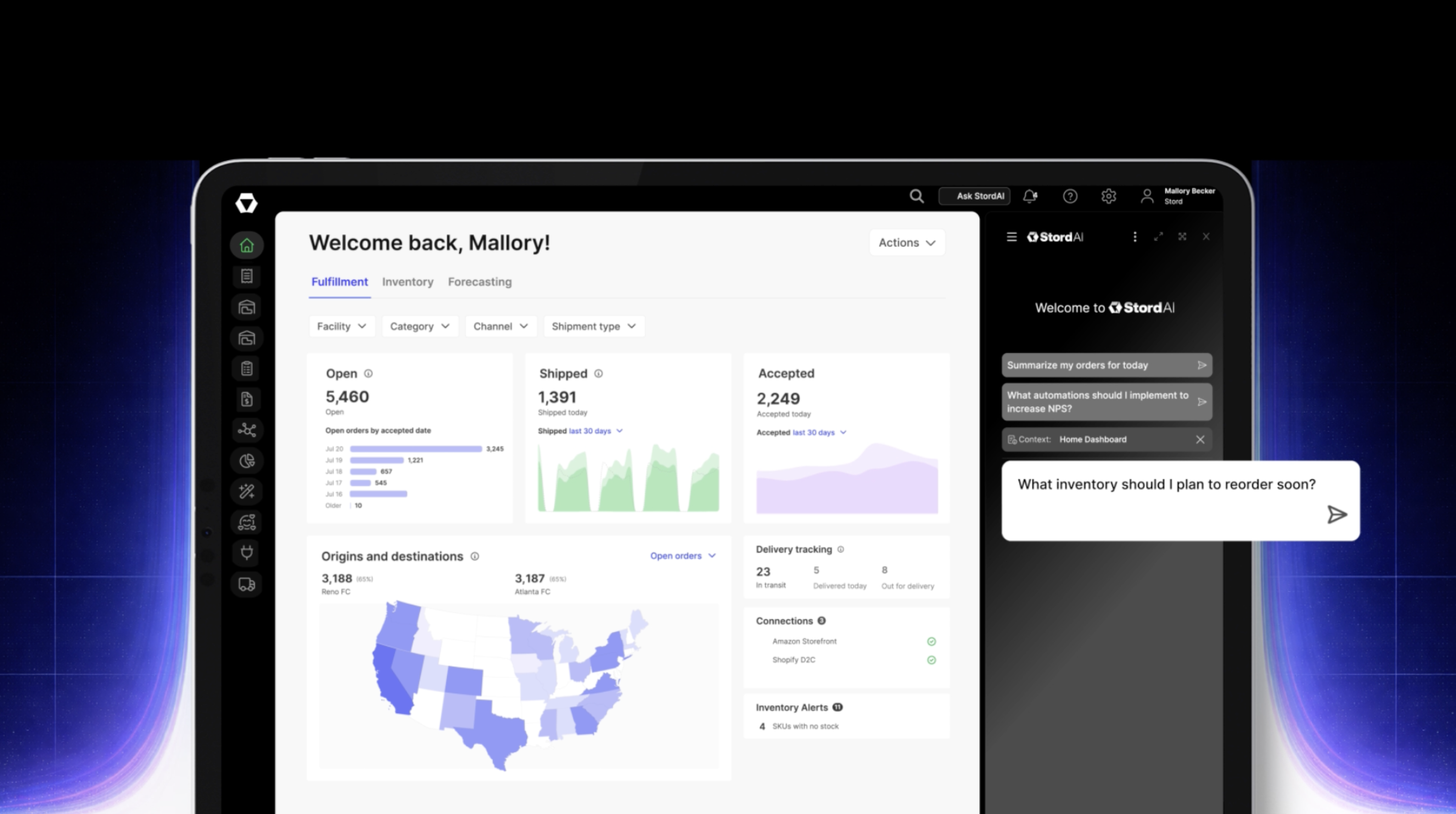
Because it is built specifically for e-commerce logistics and fulfillment, StordAI Chat understands the metrics and operational dynamics that matter most to commerce operators. It does not simply generate answers; it generates answers rooted in the real data of your business.
Taking Action at the Speed of Commerce
E-commerce has always been driven by data, but the competitive advantage lies in how quickly businesses can turn that data into action.
For years, brands have relied on dashboards, analytics teams, and reporting tools to interpret operational performance. While these have improved visibility, they could not eliminate the time delays between identifying an issue and responding to it. By enabling instant analysis of complex operational datasets, AI allows businesses to move from insight to action at the speed modern commerce requires.
The brands winning in the next five years won’t just have better data. They’ll have eliminated the gap between seeing a problem and fixing it. That’s what we’re building.
Get started with Stord
Want to explore how StordAI Chat can help your brand turn any data into actionable intelligence in seconds? Click below to learn more.


